In Simple Words
Think of a boarding pass system where low-income passengers applying to flights headed to high-resource destinations are moved into an earlier boarding group ahead of general applicants. This ensures that disadvantaged passengers get seats before capacity fills up.
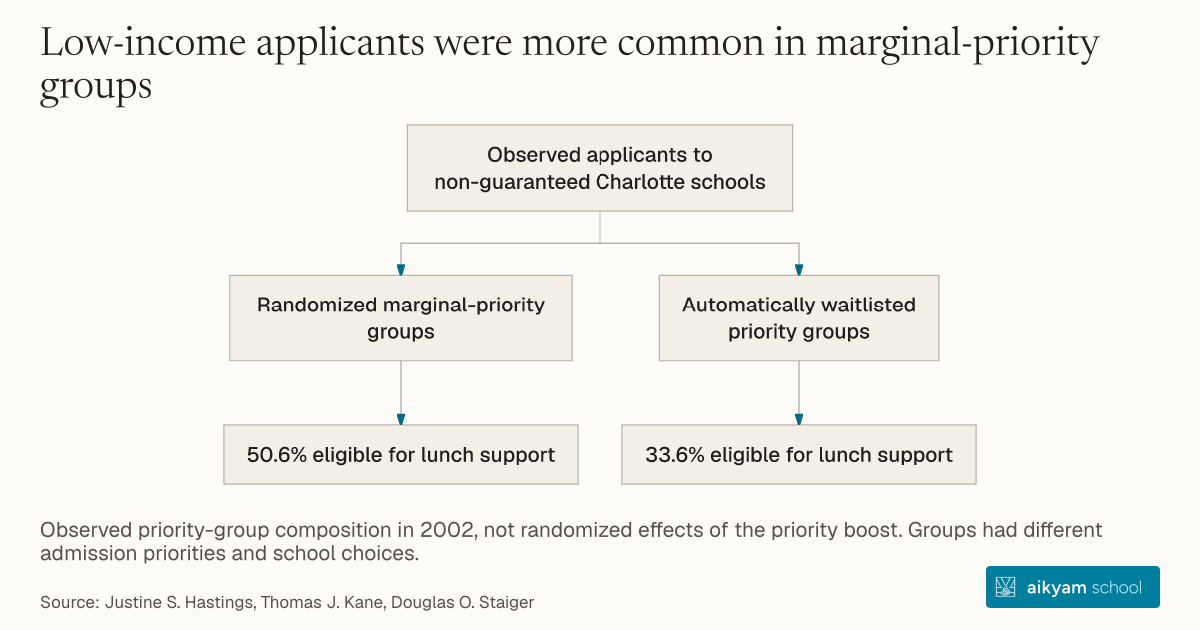
Observed applicants to non-guaranteed Charlotte schools
- Randomized marginal-priority groups
- 50.6% eligible for lunch support
- Automatically waitlisted priority groups
- 33.6% eligible for lunch support
Observed priority-group composition in 2002, not randomized effects of the priority boost. Groups had different admission priorities and school choices.
See source →Research question
Unregulated school choice lotteries can reinforce socioeconomic segregation if low-income students are crowded out of high-performing schools by higher-income applicants. Without explicit priority mechanisms, low-income families face lower probabilities of gaining admission to affluent schools.
Participants
N = 36,887 human students in Charlotte-Mecklenburg Schools, North Carolina.
Study Design
Administrative policy design giving free-lunch eligible applicants Priority 2 status when applying to schools where less than 50% of enrolled students were free-lunch eligible.
Results
Free-lunch eligible students comprised 50.6% of applicants in randomized marginal priority groups at high-performing schools compared to only 33.6% in waitlisted groups, significantly increasing low-income admission rates and counteracting strategic hedging incentives.
Takeaway
Incorporate income-contingent priority tiers in school choice allocation algorithms to guarantee low-income access to low-poverty schools.