In Simple Words
Bundling credit and training is like giving a driver both a high-performance vehicle and driving lessons at the same time. While having fuel and steering skills simultaneously should accelerate progress, the capital boost often provides the majority of the forward momentum, while gender-based social barriers can still prevent certain drivers from leaving the garage.
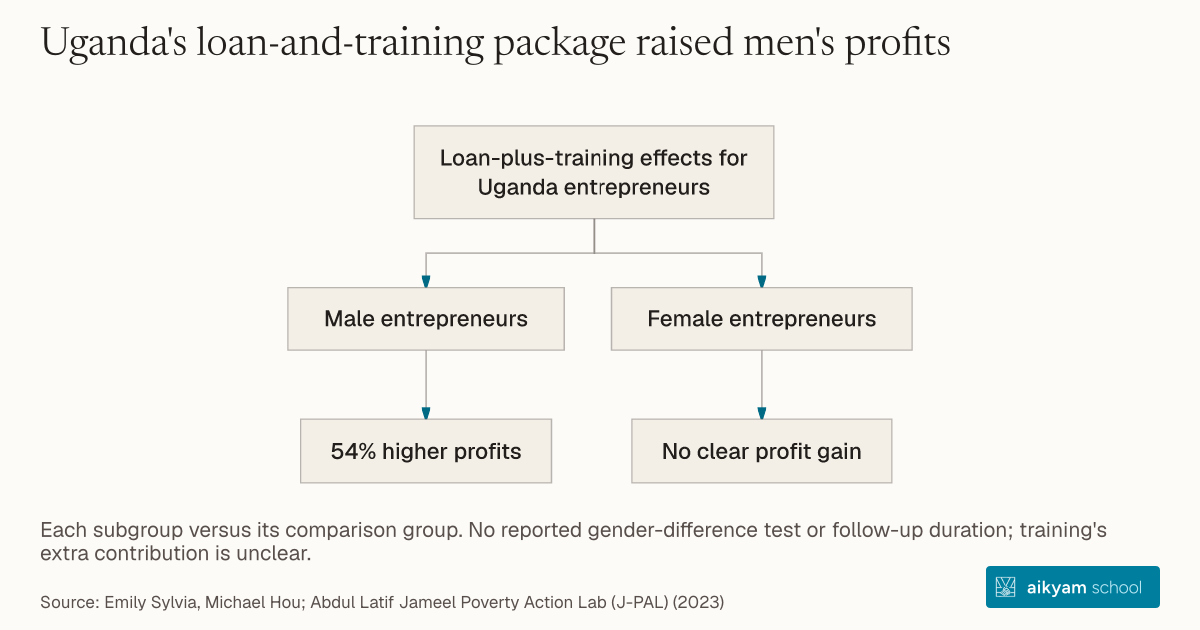
Loan-plus-training effects for Uganda entrepreneurs
- Male entrepreneurs
- 54% higher profits
- Female entrepreneurs
- No clear profit gain
Effects of loans plus classroom training, each relative to its comparison group. No subgroup difference test or follow-up duration is reported here; training's added value is unclear.
See source →Research question
Microentrepreneurs may possess business knowledge but lack liquidity to purchase inventory or capital goods, or conversely, receive microloans without the technical management capacity to deploy funds productively. Combining cash loans with traditional classroom training attempts to resolve both liquidity and human capital constraints simultaneously.
Participants
Human male and female microentrepreneurs across 7 evaluation settings, including a study in Uganda evaluating loans of US$180–$220 alongside classroom training.
Study Design
Randomized Controlled Trials (RCTs) comparing training alone, capital alone, and combined capital-plus-training programs.
Results
Bundled programs increased short-run profits, but gains were frequently driven entirely by the financial assistance component rather than training additionality; in Uganda, male entrepreneurs receiving loans and training gained 54% higher profits, whereas female profits remained completely unchanged.
Takeaway
Unbundle capital grants from mandatory classroom training requirements unless the business training curriculum is explicitly adapted to address the social and domestic constraints of the target entrepreneurs.