In Simple Words
Think of two snowballs rolled down a hill: one starts slightly bigger because it was packed with more snow at the top. As both snowballs roll for three full years, the slightly bigger one accumulates dramatically more snow because every extra layer adds even more surface area to pick up new snow.
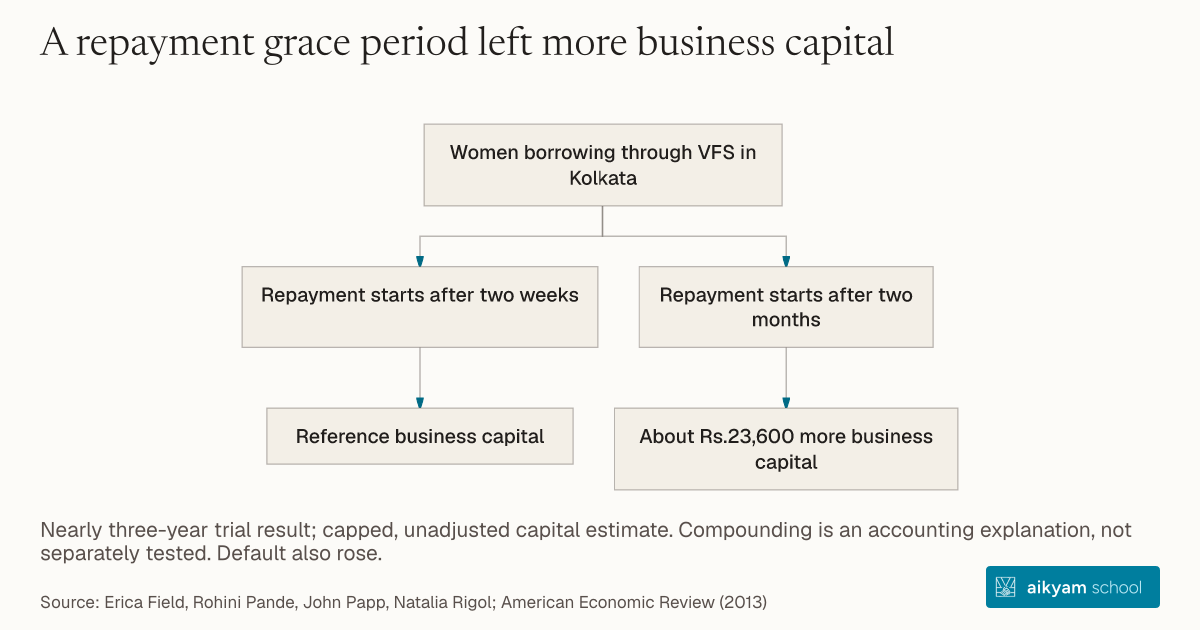
Women borrowing through VFS in Kolkata
- Repayment starts after two weeks
- Reference business capital
- Repayment starts after two months
- About Rs.23,600 more business capital
Nearly three-year trial result; capped, unadjusted capital estimate. Compounding is an accounting explanation, not separately tested. Default also rose.
See source →Research question
Small initial differences in capital investment driven by loan flexibility can lead to substantial divergences in business size and profits over multi-year horizons through persistent profit reinvestment and compounding.
Participants
766 microfinance clients tracked nearly three years post-disbursement in Kolkata, India.
Study Design
Longitudinal capital stock simulation and empirical measurement comparing initial loan investment gaps (Rs 383.9) with long-run capital stock differentials (Rs 23,600).
Results
An initial investment differential of 6.0% (Rs 383.9) compounded over 36 months at a net monthly return differential of 2.0% (6.0% vs 4.0%) produces a Rs 23,000 capital stock gap, matching the observed Rs 23,600 empirical difference at endline.
Takeaway
Evaluate microcredit flexibility interventions using multi-year follow-up horizons to capture full intertemporal compounding effects on microenterprise capital.
Source and citation
See source →Read alongside the research
Plain-English glossary
Original explanations, informed by the references below. Examples are illustrations, not data from the studies above. The research text stays unchanged.
- Longitudinal study
A study that checks the same group of people at different times. This lets researchers examine how things change over time.
ExampleResearchers ask the same workers about their wellbeing at the start, after three months and after six months.
NICE · Longitudinal study ↗Read more about longitudinal study →- Follow-up
Collecting more information about participants later in a study to see what has happened to them. The term can also mean the length of time researchers keep track of them.
ExampleResearchers interview the same workers three months after a programme ends. That later interview is a follow-up.
GET-IT glossary · Follow-up ↗Read more about follow-up →