In Simple Words
Imagine a homeowner who regularly takes out small high-interest payday loans to cover monthly maintenance and hardware costs. If someone hands them a large cash gift, instead of spending all the cash on extra tools, the homeowner uses the cash to avoid taking out new loans. The cash injection changes where their operating liquidity comes from rather than expanding the overall scale of their home projects.
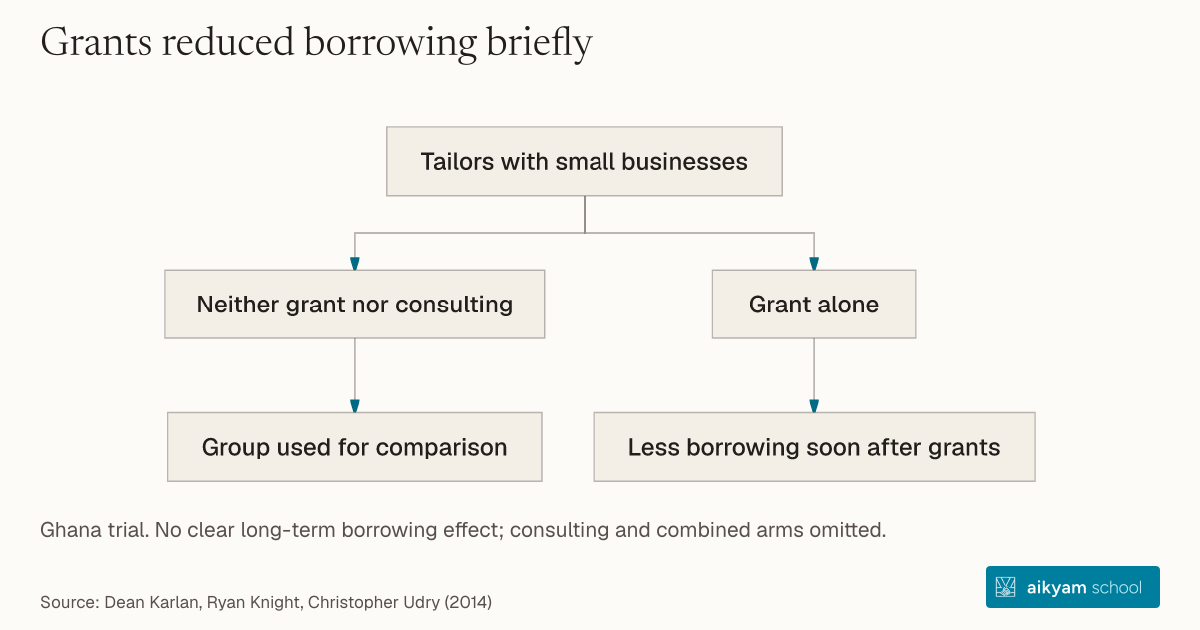
Tailors with small businesses
- Neither grant nor consulting
- Group used for comparison
- Grant alone
- Less borrowing soon after grants
Ghana trial. No clear long-term borrowing effect; consulting and combined arms omitted.
See source →Research question
Providing direct cash grants to liquidity-constrained microenterprises may alter their financial liability structure by substituting for external credit rather than generating net capital accumulation.
Participants
160 urban microenterprise tailors in Accra, Ghana, where baseline formal credit market access was 11%.
Study Design
Longitudinal tracking of financial liabilities, Susu savings, and net capital flows following an unconditional 200 cedi (~US $133) cash grant across two years.
Results
In the immediate months following the capital drop (Round 6), capital grant recipients significantly reduced loan take-up by 135.6 cedis (p < 0.05) relative to control firms, using cash grants to displace credit borrowing while increasing short-term Susu savings by 28.38 cedis per month in the combined group (p < 0.01).
Takeaway
Measure firm liability substitution and debt reduction alongside physical asset investment when evaluating cash transfer interventions.
Source and citation
See source →Read alongside the research
Plain-English glossary
Original explanations, informed by the references below. Examples are illustrations, not data from the studies above. The research text stays unchanged.
- Longitudinal study
A study that checks the same group of people at different times. This lets researchers examine how things change over time.
ExampleResearchers ask the same workers about their wellbeing at the start, after three months and after six months.
NICE · Longitudinal study ↗Read more about longitudinal study →- Baseline
The starting measurements in a study. Researchers use these to compare what participants were like at the start with what happens later.
ExampleBefore a training programme starts, researchers measure workers’ earnings. That first measurement is the baseline.
GET-IT glossary · Baseline characteristics ↗Read more about baseline →