In Simple Words
Winning a ticket to a preferred destination only improves academic health if the destination was picked for academic reasons. If a family selects a destination primarily for non-academic features like peer demographics, attending that destination may offer no academic boost or even lead to score drops.
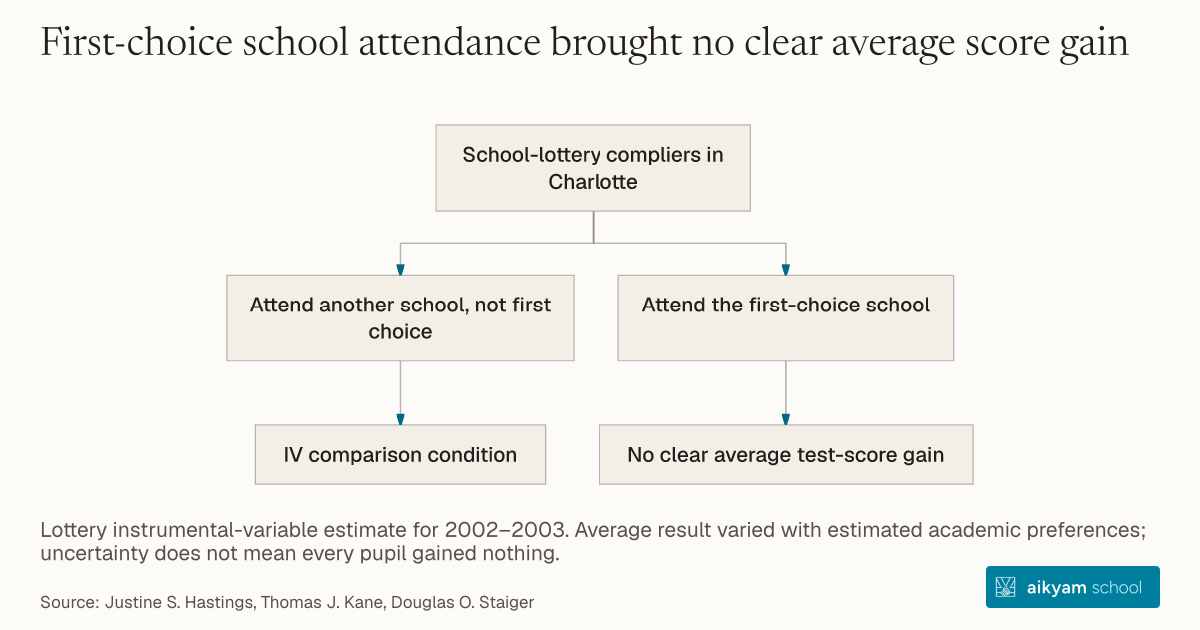
School-lottery compliers in Charlotte
- Attend another school, not first choice
- IV comparison condition
- Attend the first-choice school
- No clear average test-score gain
Lottery instrumental-variable estimate for 2002–2003. Average result varied with estimated academic preferences; uncertainty does not mean every pupil gained nothing.
See source →Research question
Evaluating public school choice via randomized lotteries often yields zero average treatment effects, masking critical underlying variation in student academic outcomes. Understanding why subgroup outcomes differ requires linking causal impacts directly to parental choice preferences and trade-offs.
Participants
N = 3,065 human students in randomized marginal lottery priority groups within Charlotte-Mecklenburg Schools, North Carolina (2,591 with complete baseline data).
Study Design
Instrumental variables (IV) estimation using oversubscribed school lottery outcomes as instruments for attending first-choice schools, interacted with estimated parental weights on test scores.
Results
Average treatment effect of attending a first-choice school across all lottery applicants is -0.005 standard deviations. Interacting attendance with test-score weight yields a positive coefficient of 0.090 with p=0.007. Students at the 95th percentile of academic preference gain approximately 0.10 standard deviations in End of Grade test scores, while disadvantaged minority students prioritizing school racial composition experience test score declines.
Takeaway
Use posterior estimates of individual choice parameters as instrumental variable interactions in randomized trial evaluations to uncover hidden treatment heterogeneity.
Source and citation
See source →Read alongside the research
Plain-English glossary
Original explanations, informed by the references below. Examples are illustrations, not data from the studies above. The research text stays unchanged.
- Baseline
The starting measurements in a study. Researchers use these to compare what participants were like at the start with what happens later.
ExampleBefore a training programme starts, researchers measure workers’ earnings. That first measurement is the baseline.
GET-IT glossary · Baseline characteristics ↗Read more about baseline →