In Simple Words
Think of a family-run bakery that buys a second oven and doubles its flour inventory, but hesitates to hire outside workers because of training costs and fear of theft. Instead of hiring employees, the family members simply work longer hours themselves, causing capital to grow much faster than worker count.
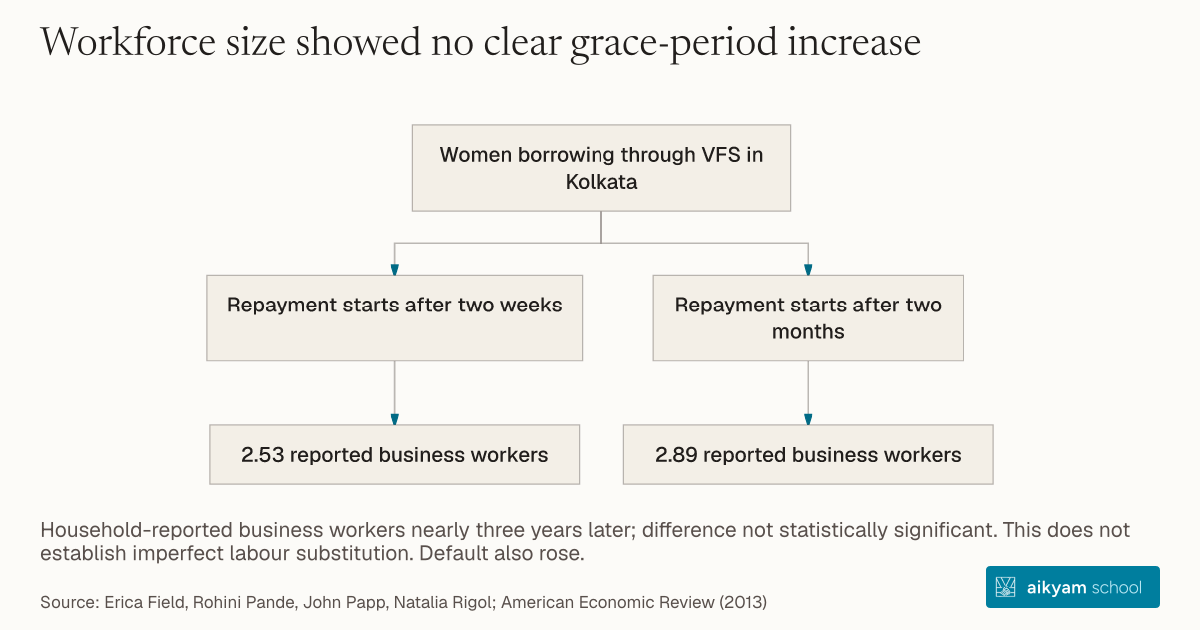
Women borrowing through VFS in Kolkata
- Repayment starts after two weeks
- 2.53 reported business workers
- Repayment starts after two months
- 2.89 reported business workers
Household-reported business workers nearly three years later; difference not statistically significant. This does not establish imperfect labour substitution. Default also rose.
See source →Research question
When micro-entrepreneurs accumulate substantial business capital and expand operations, their workforce size expands far less than proportionally due to frictions in hiring and trusting outside hired labor compared to family labor.
Participants
766 female microfinance clients in low-income neighborhoods of Kolkata, India.
Study Design
Randomized Controlled Trial measuring total business workforce size three years post-disbursement alongside capital stock expansion.
Results
Despite an 81.0% increase in business capital stock among grace period households, total enterprise workforce adjusted marginally from 2.53 workers in control to 2.89 workers in treatment, a difference that was statistically insignificant.
Takeaway
Account for family labor constraints when designing business growth interventions, recognizing that capital accumulation in microenterprises outpaces formal hiring.
Source and citation
See source →Read alongside the research
Plain-English glossary
Original explanations, informed by the references below. Examples are illustrations, not data from the studies above. The research text stays unchanged.
- Randomized controlled trial
A study that uses chance, like drawing lots, to decide who receives each option being compared. Researchers compare the groups’ outcomes to estimate the effect of those options.
ExampleA lottery assigns volunteers to a training programme or a comparison group. Researchers then compare their outcomes.
GET-IT glossary · Randomized study ↗Read more about randomized controlled trial →