In Simple Words
Think of a scholarship structured like a free gym membership that is immediately revoked if the user skips too many workouts. Because losing the membership means paying out-of-pocket or giving up the privilege, the user is strongly motivated to show up every day and finish their routine.
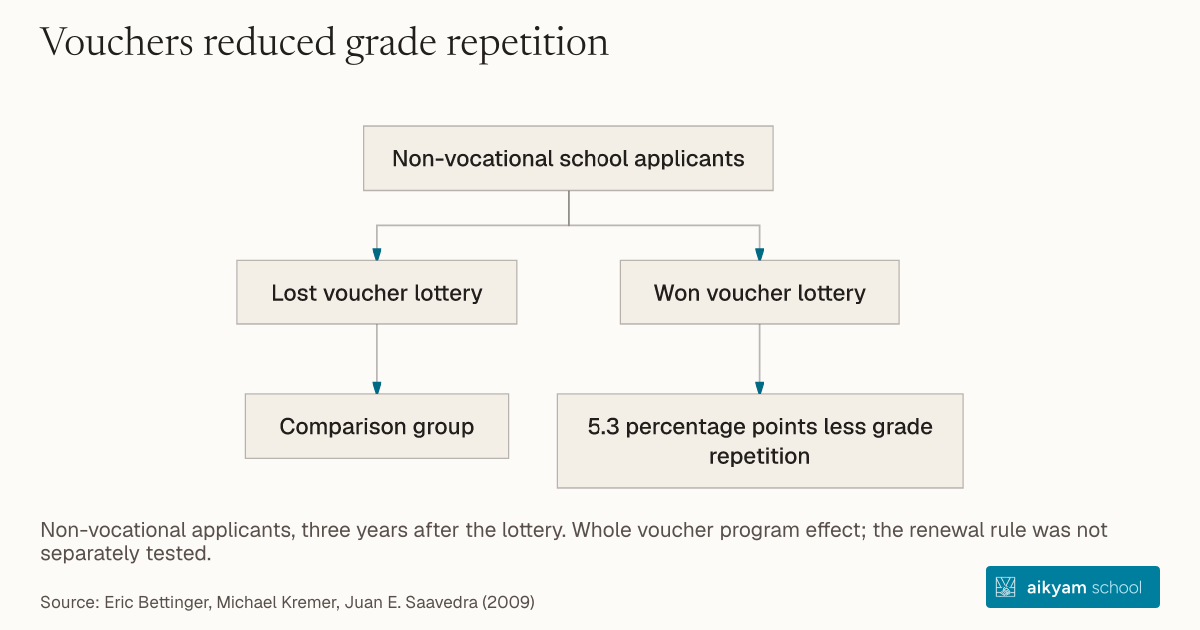
Non-vocational school applicants
- Lost voucher lottery
- Comparison group
- Won voucher lottery
- 5.3 percentage points less grade repetition
Non-vocational applicants, three years after the lottery. Whole voucher program effect; the renewal rule was not separately tested.
See source →Research question
Educational voucher programs often fail to motivate student effort directly if funding is guaranteed regardless of academic performance. Without performance requirements, students may not exert the necessary effort to remain in school or avoid grade repetition.
Participants
N = 1,176 human voucher applicants from low-income households (strata 1 and 2) in Bogotá, Colombia.
Study Design
Longitudinal randomized lottery evaluation tracking grade progression, grade repetition, and completion rates over 3-year administrative follow-ups.
Results
Conditioning voucher renewal on passing grades reduced grade repetition rates by 5.3 to 6.3 percentage points and increased 8th-grade completion rates by 8.7 to 9.4 percentage points.
Takeaway
Structure educational voucher policies to require yearly academic grade progression as a mandatory prerequisite for funding renewal.
Source and citation
See source →Read alongside the research
Plain-English glossary
Original explanations, informed by the references below. Examples are illustrations, not data from the studies above. The research text stays unchanged.
- Longitudinal study
A study that checks the same group of people at different times. This lets researchers examine how things change over time.
ExampleResearchers ask the same workers about their wellbeing at the start, after three months and after six months.
NICE · Longitudinal study ↗Read more about longitudinal study →- Percentage points
The difference between two percentages.
ExampleA rise from 40% to 50% is 10 percentage points. Relative to the starting value, that is a 25% increase.
Office for National Statistics · Percentages ↗Read more about percentage points →