In Simple Words
Picture a national talent competition where regional judges filter thousands of audition tapes down to a top tier, who then perform directly in front of major record label executives for actual contracts.
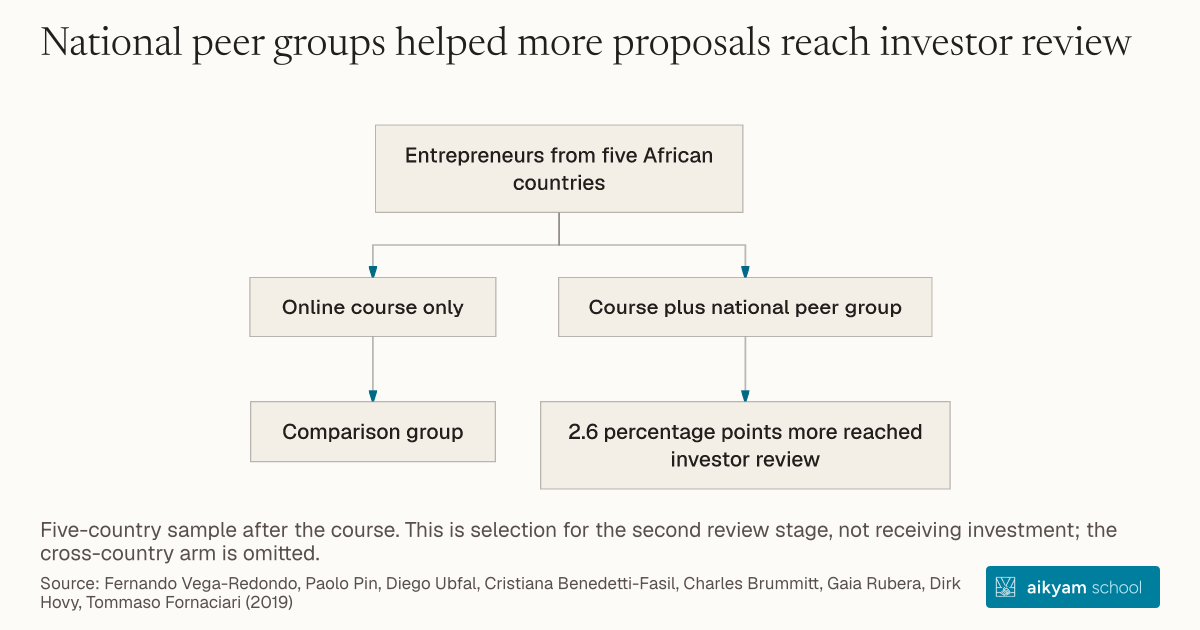
Entrepreneurs from five African countries
- Online course only
- Comparison group
- Course plus national peer group
- 2.6 percentage points more reached investor review
Five-country sample after the course. This is selection for the second review stage, not receiving investment; the cross-country arm is omitted.
See source →Research question
Evaluating early-stage business ideas across thousands of entrepreneurs requires multi-tiered vetting by local ecosystem professionals and senior venture capitalists to align project quality with funding feasibility.
Participants
N = 4,958 total entrepreneurs across 49 African countries; 15 African professional evaluators in Stage 1; 24 senior investors (VCs and angels) in Stage 2.
Study Design
Two-stage evaluation design. Stage 1 scored submitted proposals on a 1–5 scale. Stage 2 evaluated top-graded proposals (444 from Stage 1 plus 164 from Bocconi PhD panel = 608 total, 454 evaluated by investors) for funding interest.
Results
93 proposals moved to concrete investor follow-up, with up to 30 proposals funded or actively followed up by November 2018. Treatment effects on reaching Stage 2 were positive and significant for Face-to-Face ($\beta = 0.079, p < 0.10$) and Virtual-Within ($\beta = 0.026, p < 0.05$ in Large Countries), but conditional on reaching Stage 2, investor quality scores showed no differential treatment effect ($\beta = -0.081, p > 0.10$), indicating strong alignment between stage-1 ecosystem ratings and stage-2 investor criteria.
Takeaway
Implement a two-tier evaluation framework using local ecosystem experts to filter business plans before presenting top-tier proposals to senior venture capitalists for funding consideration.