Research allocation
Allocate tuition vouchers by lottery
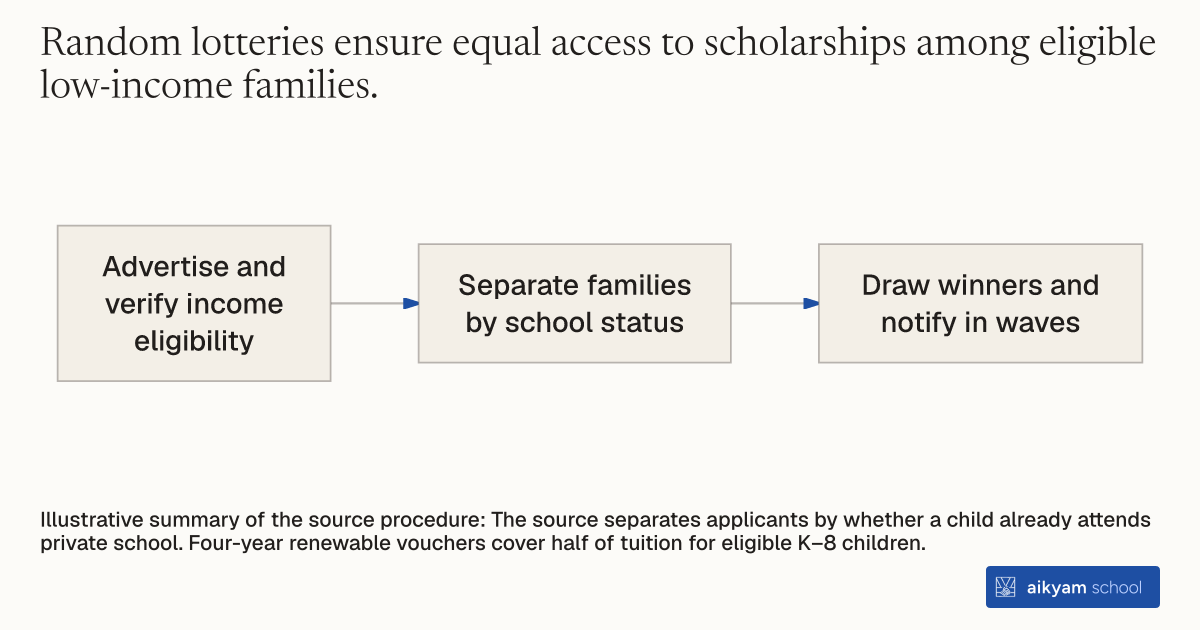
- Advertise and verify income eligibility
- Separate families by school status
- Draw winners and notify in waves
Illustrative summary of the source procedure: The source separates applicants by whether a child already attends private school. Four-year renewable vouchers cover half of tuition for eligible K–8 children.
See source →How
When to use
Low-income families want to send kindergarten through eighth grade children to private schools but cannot afford the tuition. Program managers need a fair system to distribute partial tuition scholarships when applicant demand exceeds available funds. This method awards renewable private school vouchers while creating a randomized control group for policy evaluation.
Distribute partial private school tuition vouchers to low-income families using a randomized selection procedure.
- Target advertising for four-year renewable private school scholarships to families with kindergarten through eighth grade students using radio, television, and newspaper ads.
- Require applicants to qualify for federal free or reduced-price lunch programs and verify income eligibility with tax records.
- Separate applicant families into two lottery groups based on whether any child currently attends a private school.
- Assign random selection numbers to families in each group using a central lottery office.
- Award winners vouchers covering one-half of private school tuition for all eligible children in the household.
- Notify award winners by mail and phone in separate release waves as scholarships are claimed.
Why it works
Random allocation also creates unbiased comparison groups to measure how tuition assistance alters educational and behavioral outcomes.
Example
In 1998, the Children's Scholarship Fund received 2,424 applications from low-income families in Toledo, Ohio, and awarded over 1,500 four-year renewable tuition vouchers by lottery. Vouchers paid half of private school tuition for kindergarten through eighth grade students.
About the study
Participants
2,424 low-income applicant families representing elementary and junior high students in Northwest Ohio, with 57 percent African-American applicants and 39 percent single-parent households in the public school lottery sample.
Study Design
Randomized controlled trial using a natural lottery experiment, comparing outcomes between voucher winners and unsuccessful applicant losers three to four years after the 1998 lottery.
Results
Winning the voucher increased private school attendance by 22.7 percentage points without covariates and 20.8 percentage points with basic covariates over the 20.8 percent baseline attendance of lottery losers.