Research design
Compare ratings of the same recorded speech
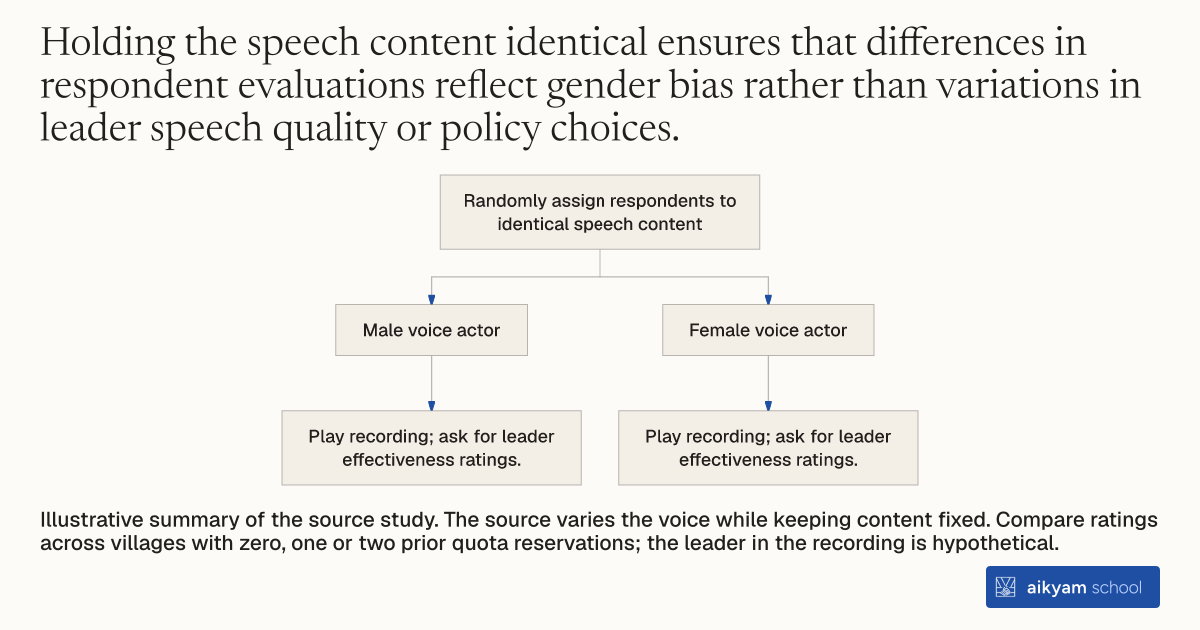
Randomly assign respondents to identical speech content
- Male voice actor
- Play recording; ask for leader effectiveness ratings.
- Female voice actor
- Play recording; ask for leader effectiveness ratings.
Illustrative summary of the source study. The source varies the voice while keeping content fixed. Compare ratings across villages with zero, one or two prior quota reservations; the leader in the recording is hypothetical.
See source →How
When to use
Evaluators need to test gender bias in leadership effectiveness ratings without confounders like visual appearance or charisma. Subjective ratings of actual politicians often reflect voter prejudice rather than true performance quality. Playing standardized audio recordings with male or female voices isolates vocal gender cues to measure perceived leader competence.
Play standardized audio recordings of a leader's speech to survey respondents using randomly varied male or female voice actors to evaluate perceived effectiveness.
- Script a short standardized speech where a village leader responds to a citizen complaint by requesting community financial contributions and effort.
- Record two identical versions of the audio speech, one read by a male voice actor and one read by a female voice actor.
- Surveyors randomly assign village respondents in sampled communities to listen to either the male or female audio recording.
- Interviewers play the recorded tape to each individual respondent during household survey visits.
- Surveyors ask respondents immediately after listening to rate the leader's performance and overall effectiveness on a standardized scale.
Example
In rural Birbhum district, West Bengal, researchers played recorded speeches to villagers in 495 village councils, finding that men in previously reserved villages rated a hypothetical female leader higher than a male leader.
About the study
Participants
Adult male and female respondents surveyed across 495 randomly selected rural villages in Birbhum district, West Bengal, India.
Study Design
Survey experiment embedded within a field trial, randomly varying the speaker's voice sex (male vs. female) on an audio recording across villages with zero, one, or two prior quota reservations.
Results
In never-reserved villages, men rated male leaders 1.45 points higher than female leaders on a 10-point scale, but exposure to female leaders reversed this bias, leading men in reserved villages to rate a hypothetical female leader above a male leader.