Research design
Assign stove offers by village
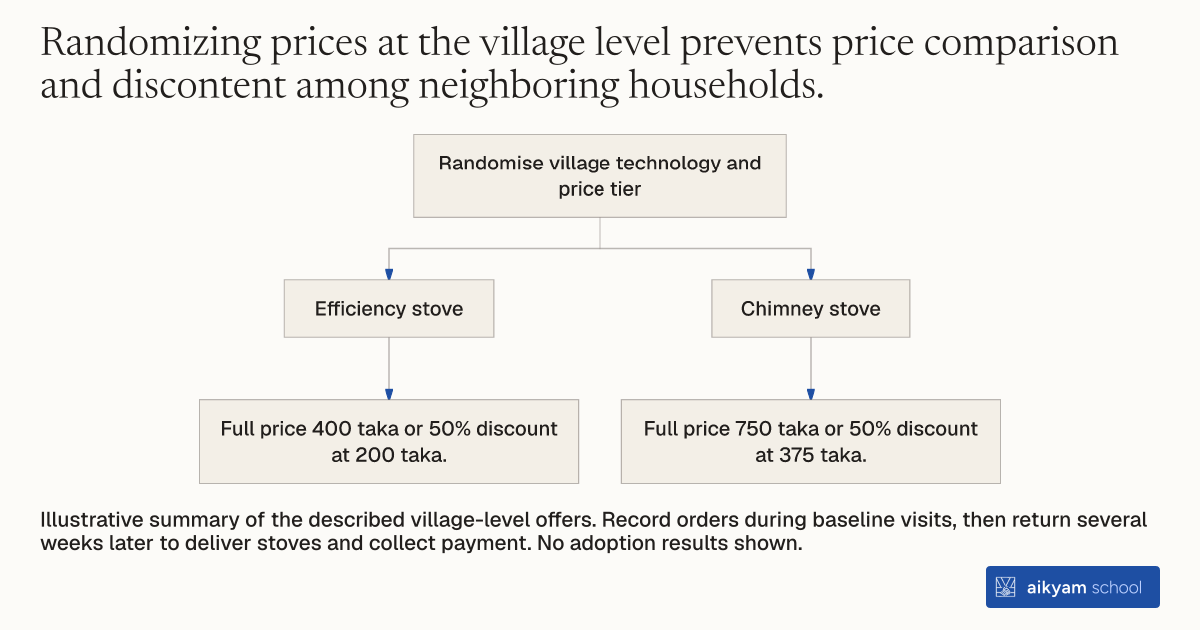
Randomise village technology and price tier
- Efficiency stove
- Full price 400 taka or 50% discount at 200 taka.
- Chimney stove
- Full price 750 taka or 50% discount at 375 taka.
Illustrative summary of the described village-level offers. Record orders during baseline visits, then return several weeks later to deliver stoves and collect payment. No adoption results shown.
See source →How
When to use
Development programs face uncertainty regarding how pricing discounts affect real-world adoption of health technologies. Individual randomization risks spillover effects and price discontent among neighbors. Cluster-randomization at the village level isolates price sensitivity and evaluates full-price versus subsidized adoption rates under real-world market conditions.
Assign technology types and price discounts at the village level to measure price sensitivity and household adoption decisions.
- Select rural study villages across ecologically diverse districts and randomly assign each village to a technology type and price tier.
- Market fuel-efficiency cookstoves at full price (৳400) or 50% discount (৳200) in assigned efficiency villages.
- Market chimney smoke-reducing cookstoves at full price (৳750) or 50% discount (৳375) in assigned chimney villages.
- Conduct baseline household surveys and record initial purchase orders placed with field marketers.
- Manufacture ordered stoves and return several weeks later to deliver products and collect cash payments.
Why it works
The orthogonal assignment of cookstove designs and prices isolates how specific product attributes and discounts influence real-world purchase decisions.
Example
Researchers implemented this experiment across 42 villages in Hatiya and Jamalpur, Bangladesh, in 2008. Full-price adoption was 5% for efficiency stoves and 2% for chimney stoves, while a 50% subsidy raised adoption by 8 to 12 percentage points for efficiency stoves and 5 to 6 percentage points for chimney stoves.
About the study
Participants
2,280 households across 42 villages in Hatiya and Jamalpur, Bangladesh.
Study Design
Cluster-randomized trial orthogonalizing technology assignment (efficiency vs. chimney) and price discount (full price vs. 50% subsidy) across 42 study villages between July 2008 and February 2009.
Results
Full-price adoption was 5% for efficiency stoves and 2% for chimney stoves; a 50% discount increased efficiency stove adoption by 8 to 12 percentage points and chimney stove adoption by 5 to 6 percentage points.