Research steps
Compare parents’ daily time use
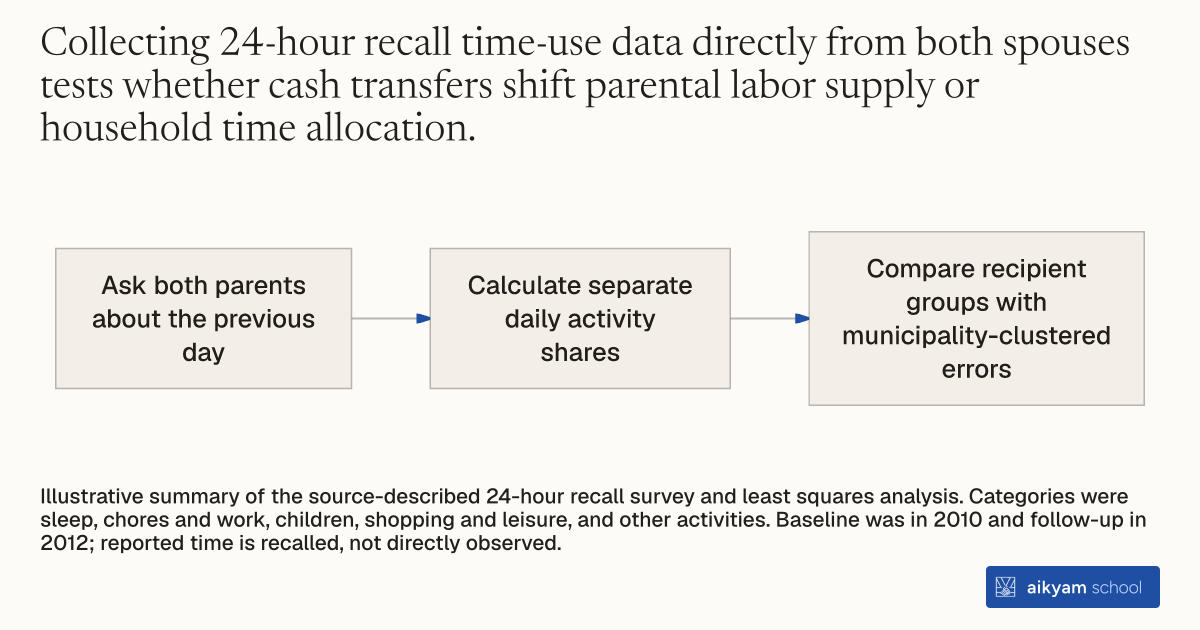
- Ask both parents about the previous day
- Calculate separate daily activity shares
- Compare recipient groups with municipality-clustered errors
Illustrative summary of the source-described 24-hour recall survey and least squares analysis. Categories were sleep, chores and work, children, shopping and leisure, and other activities. Baseline was in 2010 and follow-up in 2012; reported time is recalled, not directly observed.
See source →How
When to use
Evaluating whether cash transfers change household spending through altered parental time allocation rather than direct resource control requires tracking daily activities. Cash transfers paid to mothers might alter how fathers or mothers divide time between work, house chores, childcare, and leisure. Collecting time-use data tests whether recipient gender changes daily time allocation for poor parents.
Collect 24-hour recall time-use data from both parents across standardized daily activity categories during evaluation surveys.
- Survey enumerators interview both mothers and fathers during household evaluation survey rounds.
- Ask each parent to report the amount of time spent on specific activities during the day before the interview.
- Categorize time spent into 24-hour daily shares covering sleeping, house chores and working, time with children, shopping and leisure, and other activities.
- Calculate the share of the day spent on each activity category for fathers and mothers separately.
- Estimate least squares regressions comparing daily time shares between mother-recipient and household-head-recipient municipalities.
- Cluster standard errors at the municipality level to test for treatment impacts on parental time use.
Why it works
Comparing time shares across treatment arms isolates whether spending changes stem from altered time use or altered income control.
Example
Researchers in Macedonia surveyed 876 parents at baseline and 803 parents at follow-up across 84 municipalities to evaluate the conditional cash transfer program. Fathers and mothers reported daily time shares across sleeping, house chores and working, childcare, shopping and leisure, and other activities, revealing no statistically significant differences in time allocation between treatment groups.
About the study
Participants
876 parents at baseline (428 in HH municipalities, 448 in Mother municipalities) and 803 fathers / 810 mothers at follow-up across 84 municipalities in Macedonia.
Study Design
24-hour recall time-use module embedded in the evaluation survey during baseline (2010) and follow-up (2012) rounds of a randomized trial.
Results
Mothers spent 38.2 percent of the day sleeping, 23.2 percent on chores and work, 14.1 percent with children, and 8.7 percent on shopping and leisure at follow-up, with zero statistically significant differences between mother-recipient and household-head-recipient municipalities.