Research survey
Track plant operations over time
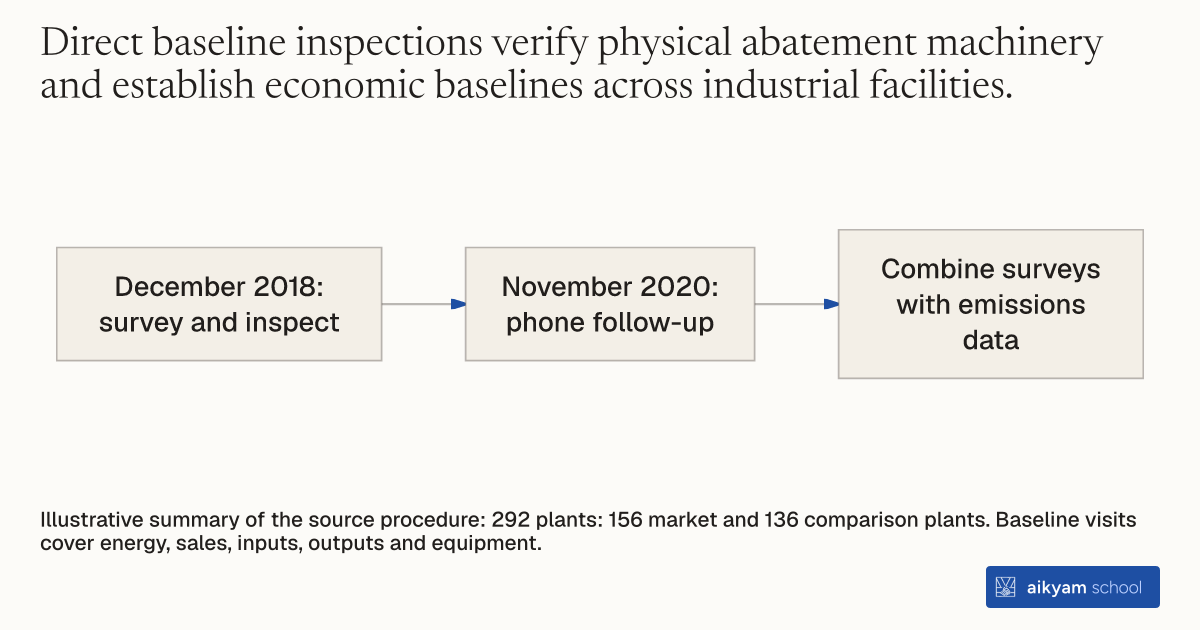
- December 2018: survey and inspect
- November 2020: phone follow-up
- Combine surveys with emissions data
Illustrative summary of the source procedure: 292 plants: 156 market and 136 comparison plants. Baseline visits cover energy, sales, inputs, outputs and equipment.
See source →How
When to use
Evaluators measuring regulatory impacts on industrial plants need data on firm operations, energy use, and pollution abatement equipment. Automated monitoring devices track emissions but cannot measure economic inputs, plant sales, or physical machinery. Conducting baseline in-person and follow-up phone surveys collects plant-level economic and operational data alongside continuous emissions monitoring.
Collect plant-level economic and operational data from factory owners using in-person baseline visits and follow-up phone calls.
- Conduct an in-person baseline survey with firm owners in December 2018 prior to market launch.
- Interview factory owners about plant energy consumption, sales, inputs, and outputs during baseline visits.
- Inspect plant premises during baseline visits to observe sources of pollution and installed pollution abatement equipment.
- Administer a follow-up survey over the phone with plant managers in November 2020 during active market evaluation.
Why it works
Combining in-person baseline visits with follow-up phone interviews tracks changes in factory operations and compliance costs across regulatory cycles.
Example
Researchers conducted an in-person baseline survey in December 2018 and a phone follow-up survey in November 2020 across 292 industrial textile plants in Surat, India.
About the study
Participants
292 small and medium industrial textile plants in Surat, Gujarat, India (156 market intervention plants and 136 comparison plants).
Study Design
Randomized Controlled Trial evaluating 292 factories using an in-person baseline survey in December 2018 and a follow-up phone survey in November 2020 alongside continuous emissions monitoring.
Results
Survey data combined with continuous emissions monitoring showed that market group firms reduced particulate matter emissions by 20 to 30 percent relative to comparison firms without increasing overall abatement costs.