Try, learn and adjust
Check credit-financed assets and repayments
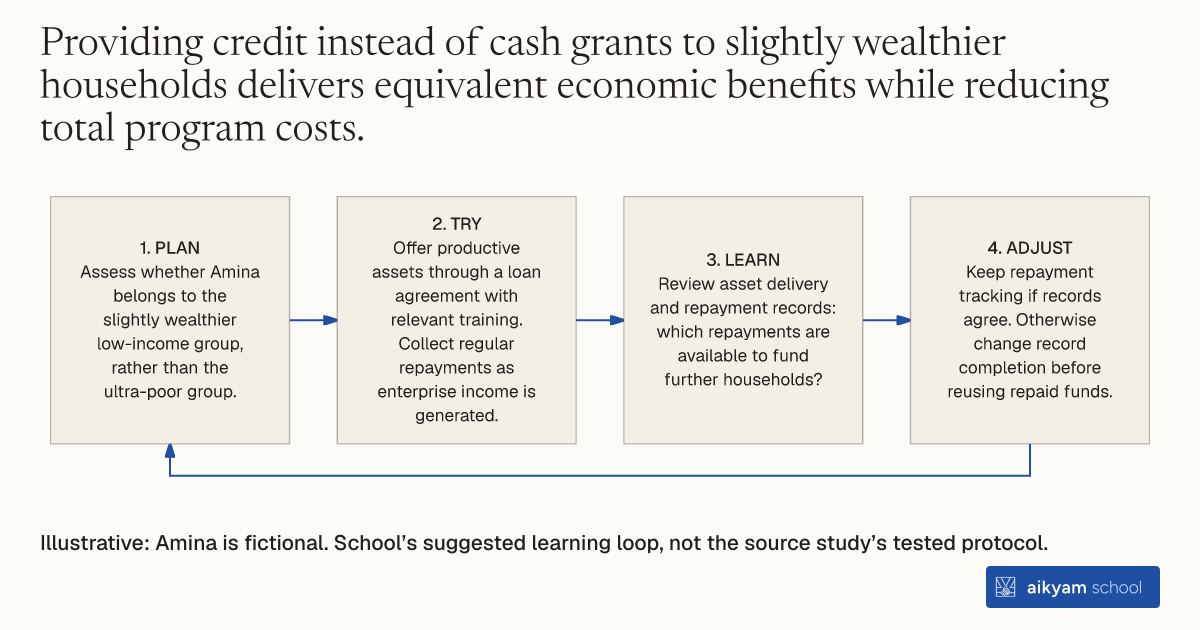
- Plan: Assess whether Amina belongs to the slightly wealthier low-income group, rather than the ultra-poor group.
- Try: Offer productive assets through a loan agreement with relevant training. Collect regular repayments as enterprise income is generated.
- Learn: Review asset delivery and repayment records: which repayments are available to fund further households?
- Adjust: Keep repayment tracking if records agree. Otherwise change record completion before reusing repaid funds.
Illustrative: Amina is fictional. School’s suggested learning loop, not the source study’s tested protocol.
See source →School’s suggested learning loop: observe asset delivery and repayments; this check does not establish that credit and grants have equal effects.
How
When to use
Providing free capital grants to all low-income households is costly and restricts program scalability. Slightly wealthier poor families can build self-employment, but giving them outright grants may be financially unnecessary. Supply productive assets through credit to slightly wealthier beneficiaries to enhance program sustainability and scale.
Deliver productive assets to slightly wealthier low-income beneficiaries using credit financing instead of outright grants.
- Program managers evaluate household wealth levels to identify beneficiaries who are slightly wealthier than ultra-poor participants.
- Field staff offer productive assets structured under credit or loan agreements rather than direct cash grants.
- Implementation teams deliver the chosen productive assets alongside relevant management training.
- Program officers collect regular credit repayments as participants generate income from their enterprises.
- Implementation partners reuse repaid credit funds to extend asset access to additional households.
Why it works
Modifying the funding model creates a more financially sustainable and scalable livelihood intervention.
Example
In Bangladesh, a study showed that extending credit to slightly wealthier participants was as beneficial as providing cash grants, enabling a more scalable funding model.