Try, learn and adjust
Check remote training delivery
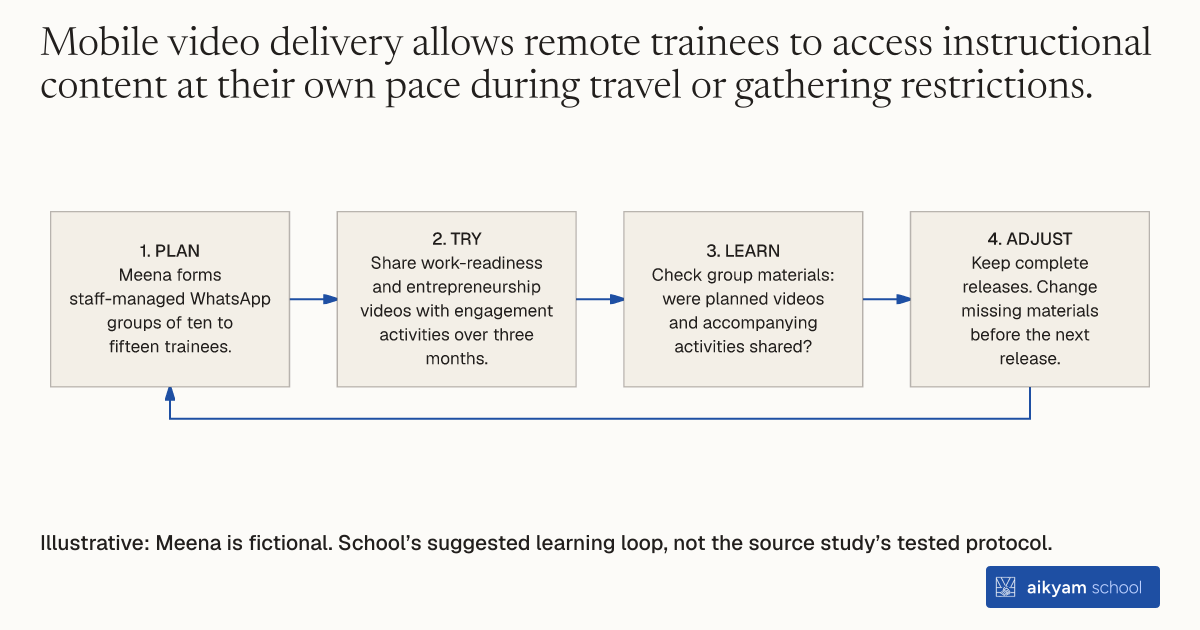
- Plan: Meena forms staff-managed WhatsApp groups of ten to fifteen trainees.
- Try: Share work-readiness and entrepreneurship videos with engagement activities over three months.
- Learn: Check group materials: were planned videos and accompanying activities shared?
- Adjust: Keep complete releases. Change missing materials before the next release.
Illustrative: Meena is fictional. School’s suggested learning loop, not the source study’s tested protocol.
See source →School’s suggested learning loop checks delivery, separately from the study’s training intervention. Study results are forthcoming.
How
When to use
Vocational training providers need to deliver educational content to young jobseekers during remote or lockdown conditions. In-person instruction can be restricted by public health measures or geographic distance in rural communities. Mobile video training provides accessible modules on work readiness and entrepreneurship directly to participants' smartphones.
Deliver work-readiness and entrepreneurship training videos to jobseekers using mobile messaging groups over three months.
- Form WhatsApp messaging groups of ten to fifteen trainees managed by project staff.
- Share online training video modules covering entrepreneurship development and work-readiness directly within the messaging groups.
- Schedule interactive engagement activities alongside video releases to reinforce concepts.
- Distribute instructional materials remotely over the course of three months.
Why it works
Structured engagement activities inside messaging groups promote peer interaction and learning retention.
Example
Researchers and Yuva Parivartan delivered online work-readiness and entrepreneurship development videos with engagement activities to 24 WhatsApp groups of young jobseekers in rural and peri-urban Maharashtra, India. Trainees accessed digital materials remotely over three months during COVID-19 pandemic restrictions.
About the study
Participants
24 trainee groups containing 10 to 15 young jobseekers each in peri-urban and rural Maharashtra, India.
Study Design
Four-arm randomized controlled trial testing online video training against a control group and two livelihood assistance variants.
Results
Study ongoing and results are forthcoming; baseline phone surveys established pre-intervention status across study groups.