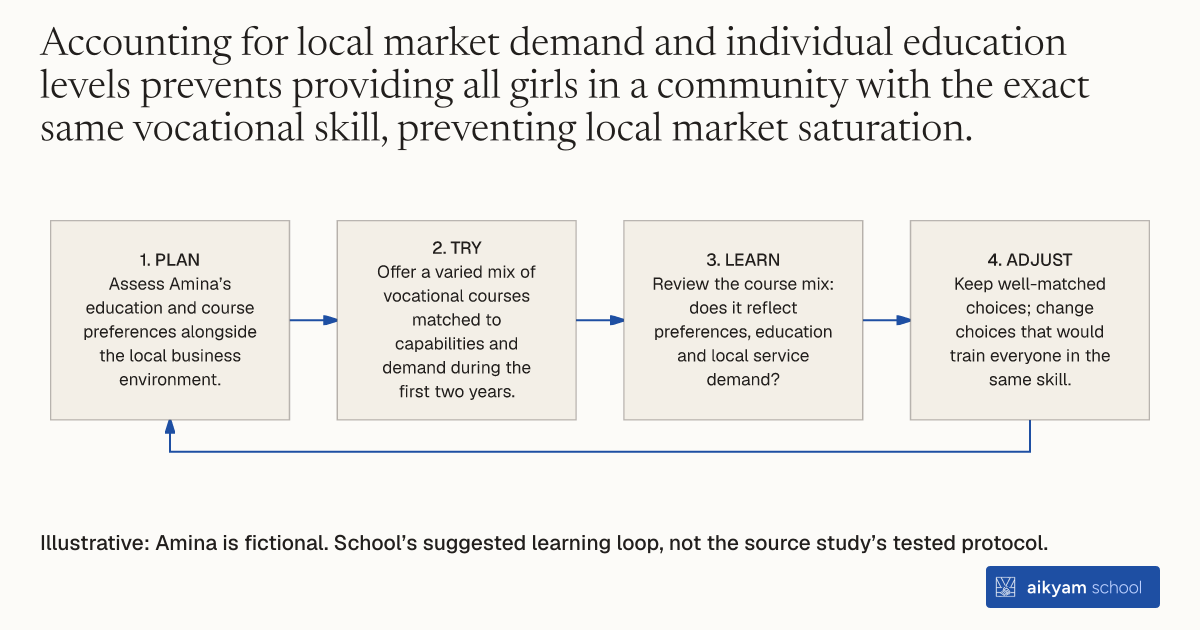
Try, learn and adjust
Check course choices fit girls and local demand
- Plan: Assess Amina’s education and course preferences alongside the local business environment.
- Try: Offer a varied mix of vocational courses matched to capabilities and demand during the first two years.
- Learn: Review the course mix: does it reflect preferences, education and local service demand?
- Adjust: Keep well-matched choices; change choices that would train everyone in the same skill.
Illustrative: Amina is fictional. School’s suggested learning loop, not the source study’s tested protocol.
See source →School’s suggested loop, not a tested source procedure. Observe participant preferences, backgrounds and demand; do not assume business success.
How
When to use
Adolescent girls in developing countries face varied educational backgrounds and localized economic conditions when seeking employment. Delivering uniform vocational courses to all girls in a community can cause local market saturation and mismatch participant capabilities. Match course selection to participant preferences, education levels, and local commercial demand to maximize micro-enterprise success.
Tailor vocational course offerings to participant capabilities and local market conditions to avoid local business saturation.
- Program managers assess the local business environment and commercial demand for specific services in each community.
- Staff evaluate the education levels and prior background of eligible adolescent club members.
- Club leaders gather course preferences from participating girls to ensure training aligns with participant demand.
- Program coordinators select a diversified mix of technical courses, including hair-dressing, tailoring, computing, agriculture, poultry rearing, and small trades.
- Instructors deliver matched vocational courses during club meetings across the first two years of operation.
Why it works
Combining participant preferences with market analysis ensures high course uptake and improves the economic viability of newly created micro-enterprises.
Example
BRAC matched vocational courses across 100 treated communities in Uganda, providing training to 2,000 members in year one and 1,000 members in year two. Diversifying skills based on local commercial demand and educational background helped increase self-employment rates by 50% four years post-intervention without displacing formal school attendance.
About the study
Participants
4,888 adolescent girls tracked at midline and 3,522 at endline across 150 communities in Kampala, Mukono, Iganga, and Jinja, Uganda, with average baseline age of 16.3 years.
Study Design
Cluster randomized control trial across 150 communities (100 treatment, 50 control) stratified by 10 branch offices, evaluating outcomes at baseline, midline (2 years), and endline (4 years) using OLS ANCOVA and Lee bounds.
Results
Four years post-intervention, engagement in income-generating activities increased by 48%, self-employment rates rose by 50%, teen pregnancy fell by 34%, early marriage/cohabitation dropped by 62%, and reporting sex against will decreased by 31%.