Try, learn and adjust
Check early earned wages and final balances
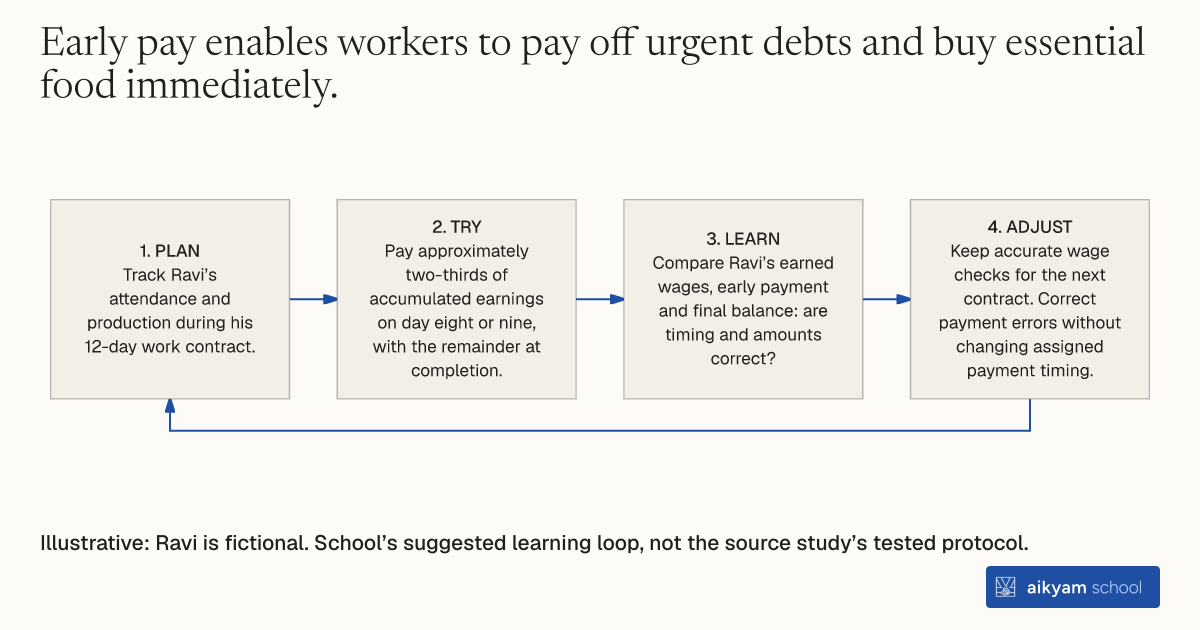
- Plan: Track Ravi’s attendance and production during his 12-day work contract.
- Try: Pay approximately two-thirds of accumulated earnings on day eight or nine, with the remainder at completion.
- Learn: Compare Ravi’s earned wages, early payment and final balance: are timing and amounts correct?
- Adjust: Keep accurate wage checks for the next contract. Correct payment errors without changing assigned payment timing.
Illustrative: Ravi is fictional. School’s suggested learning loop, not the source study’s tested protocol.
See source →School’s suggested, untested loop. Observe accrued earnings and payments; do not assume Ravi achieves the average productivity gain.
How
When to use
Low-income wage workers facing chronic poverty experience intense financial worry near payment dates. Withholding all earned wages until full contract completion causes financial stress that hurts workplace productivity. Disbursing partial earned wages early provides liquidity relief and restores output.
Disburse a partial payment of earned wages midway through a work contract to relieve financial stress.
- Assign employees to a fixed-term work contract with clear pay terms and daily output goals.
- Track daily attendance and work production across the first half of the contract period.
- Calculate accrued earnings for each worker midway through the total contract duration.
- Pay workers approximately two-thirds of their accumulated earnings on day eight or nine of the contract.
- Disburse the remaining balance upon final completion of the work contract.
Why it works
Relieving immediate financial anxiety frees up cognitive attention for better work focus and higher production speed.
Example
In Odisha, India, 224 leaf-plate workers received two-thirds of their salary early on day eight or nine of a 12-day contract, while 183 comparison workers received full payment on day 12.
About the study
Participants
408 human male wage laborers aged 18–55 across 47 villages in Odisha, India.
Study Design
Randomized Controlled Trial assigning 224 workers to early mid-contract payment and 183 workers to end-of-contract payment during a 12-day leaf-plate manufacturing contract.
Results
Early pay increased overall output by 0.27 leaf plates per hour (a 7 percent increase). Among high financial strain workers, output increased by 0.5 plates per hour. Within three days of early pay, loan repayment likelihood rose 40 percentage points, food spending rose 25 percent, and general spending rose 65 percent.