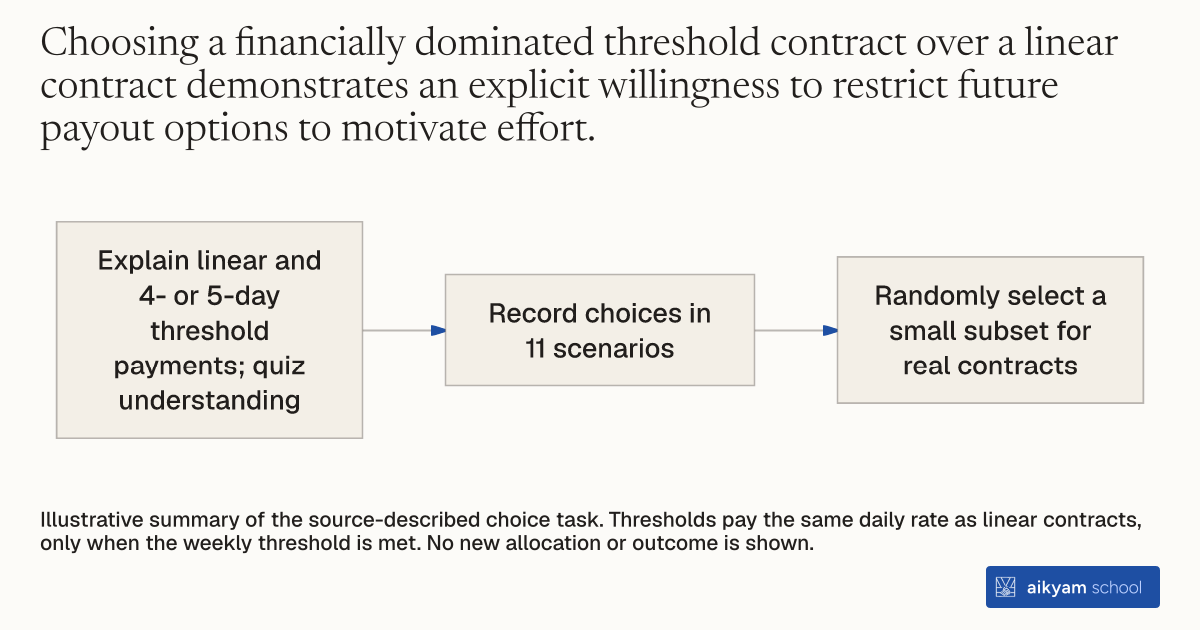
Research steps
Record choices about commitment
- Explain linear and 4- or 5-day threshold payments; quiz understanding
- Record choices in 11 scenarios
- Randomly select a small subset for real contracts
Illustrative summary of the source-described choice task. Thresholds pay the same daily rate as linear contracts, only when the weekly threshold is met. No new allocation or outcome is shown.
See source →How
When to use
Behavioral health programs need to evaluate whether individuals recognize their own present bias over effort and actively demand commitment devices. Financially dominated contracts require individuals to achieve multi-day target thresholds without receiving extra compensation compared to linear per-day plans. This method serves researchers and program designers identifying sophisticated present bias among adult populations tracking health goals.
Elicit incentivized choices between standard linear contracts and financially dominated threshold contracts to measure participant demand for commitment.
- Present participants with pair-wise choices comparing a standard linear contract against financially dominated threshold contracts.
- Structure the threshold options to pay the exact same daily rate as the linear contract but only conditional on achieving a weekly target threshold of 4 or 5 days.
- Use visual aids to explain contract payment structures and highlight that threshold contracts offer lower expected payouts for equivalent walking effort.
- Administer comprehension quizzes following the visual explanations to confirm that participants understand the dominated payment schedules.
- Record participants' choices across 11 decision scenarios using the strategy method.
- Randomly select a small subset of decisions for actual implementation and assign participants to their selected contract.
Why it works
This choice reveals sophisticated present bias, as participants voluntarily adopt stricter rules to counteract expected self-control failures.
Example
Surveyors presented visual aids and choice menus to trial participants across Coimbatore, India, to elicit preferences between linear and dominated threshold contracts. Across the sample, 51 percent of participants chose the 4-day threshold and 46 percent chose the 5-day threshold over the standard linear contract.
About the study
Participants
2,871 participants in Coimbatore, India, with an average age of 49.56 years, 42 percent female, 67 percent diagnosed diabetic, and an average monthly per capita income of 4,465 INR.
Study Design
An incentive-compatible choice elicitation using visual aids, understanding quizzes, and the strategy method across 11 decision pairs, with a small fraction of choices randomly implemented for participant contract assignment.
Results
Demand for commitment was high, with 51 percent of participants selecting the 4-day threshold and 46 percent selecting the 5-day threshold over the linear contract; selecting threshold contracts predicted a 6.06 percentage point higher compliance advantage under threshold contracts during the trial.