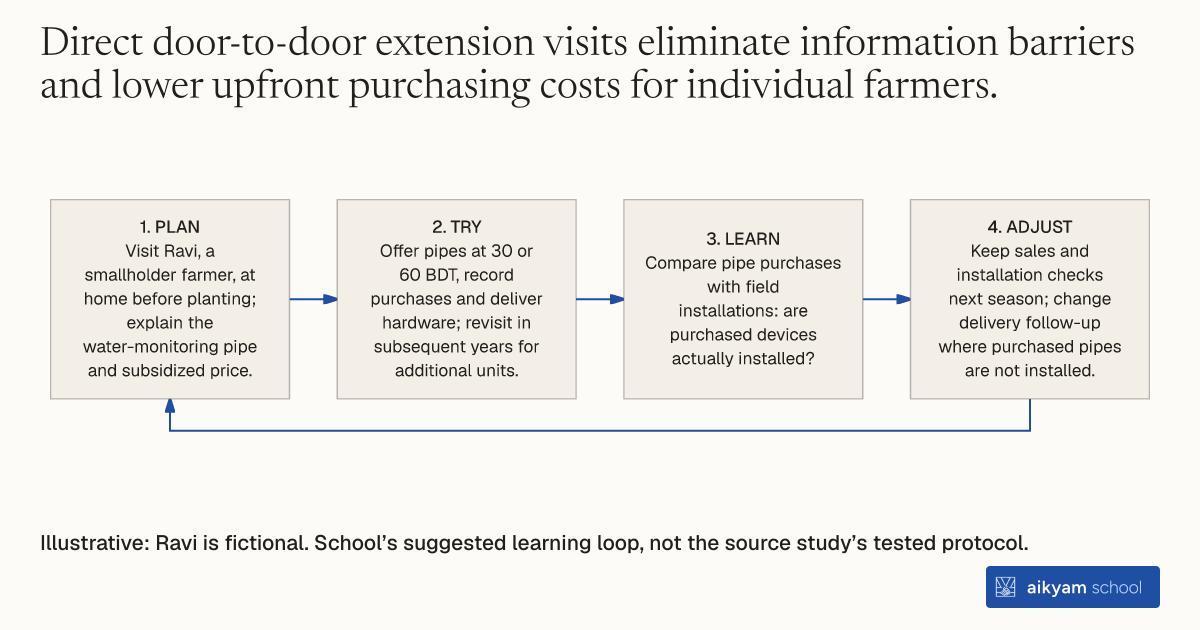
Try, learn and adjust
Check farmer pipe sales lead to installation
- Plan: Visit Ravi, a smallholder farmer, at home before planting; explain the water-monitoring pipe and subsidized price.
- Try: Offer pipes at 30 or 60 BDT, record purchases and deliver hardware; revisit in subsequent years for additional units.
- Learn: Compare pipe purchases with field installations: are purchased devices actually installed?
- Adjust: Keep sales and installation checks next season; change delivery follow-up where purchased pipes are not installed.
Illustrative: Ravi is fictional. School’s suggested learning loop, not the source study’s tested protocol.
See source →School’s suggested, untested learning loop. Observe purchases, installations and pumping electricity; farmer targeting did not produce a statistically significant Year 2 electricity reduction.
How
When to use
Standard agricultural development programs deliver resource-saving technologies directly to individual land-cultivating farmers through household visits. Extension services use this method to encourage technology adoption among smallholders by offering direct information and subsidized hardware at their homes. However, this approach assumes individual farmers have decision authority and direct financial incentives to alter irrigation pumping.
Deliver technology information and subsidized hardware directly to individual farm households through door-to-door visits at planting time.
- Identify all smallholder farmers cultivating land within a targeted agricultural zone prior to the growing season.
- Send an extension worker or enumerator individually to each farmer's home right before planting.
- Explain to the farmer how the water-saving device operates and its agronomic benefits.
- Offer the farmer the option to purchase the technology at a subsidized price.
- Record the number of devices purchased per household and deliver the hardware directly to the farmer.
- Re-visit households in subsequent years to offer replacement or additional subsidized units.
Why it works
However, because farmers pay fixed seasonal water fees while pump owners bear variable pumping costs, targeting buyers fails to align technology adoption incentives with variable cost reduction.
Example
Enumerators visited farmers across 105 villages in Mymensingh and Kishoreganj, Bangladesh, selling an average of 10.65 Alternate Wetting and Drying pipes per village in Year 1 at subsidized prices of 30 or 60 BDT. However, only 3.97 pipes per village were actually installed in fields, and Year 2 pumping electricity usage dropped by an insignificant 0.191 log points compared to control villages.
About the study
Participants
N = 105 villages across 9 upazilas in Bangladesh involving baseline surveys of 2,820 farmers.
Study Design
Randomized Controlled Trial comparing door-to-door individual farmer targeting against control villages (45 villages), measuring sales uptake, field installations, and pump electricity meter logs over two years.
Results
Door-to-door farmer visits resulted in 10.65 pipes sold per village in Year 1 and 1.60 sold in Year 2, with 3.97 and 2.82 pipes installed respectively; electricity reductions in Year 2 (-0.191 log points) were statistically indistinguishable from control and significantly smaller than seller-targeted subsidies.