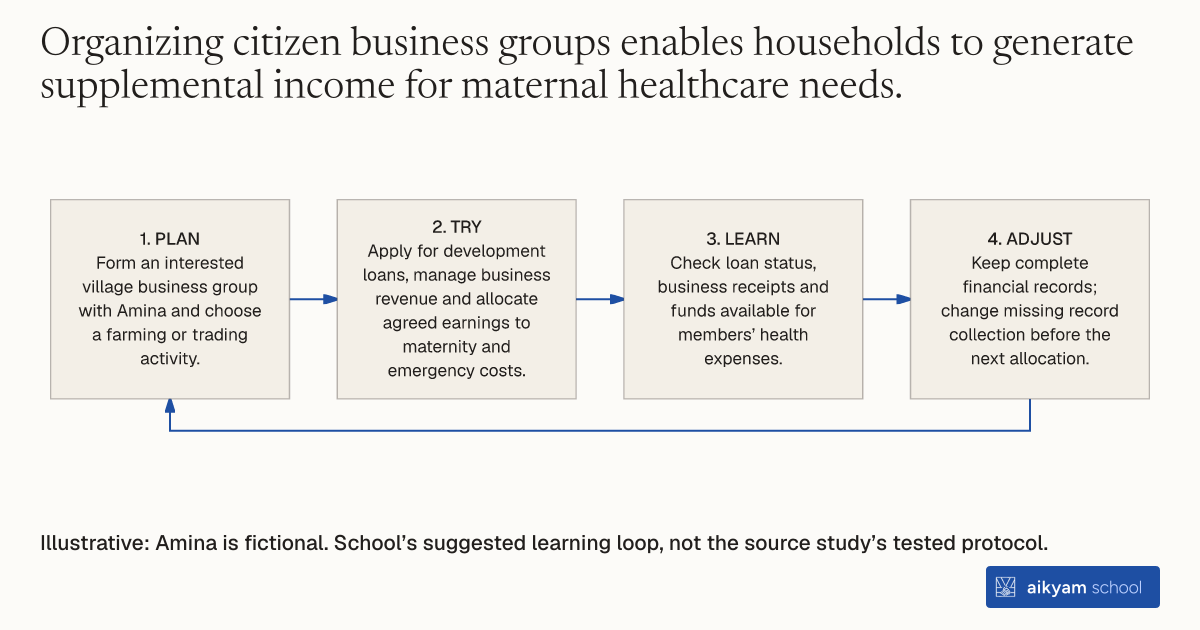
Try, learn and adjust
Check group earnings support maternity costs
- Plan: Form an interested village business group with Amina and choose a farming or trading activity.
- Try: Apply for development loans, manage business revenue and allocate agreed earnings to maternity and emergency costs.
- Learn: Check loan status, business receipts and funds available for members’ health expenses.
- Adjust: Keep complete financial records; change missing record collection before the next allocation.
Illustrative: Amina is fictional. School’s suggested learning loop, not the source study’s tested protocol.
See source →Observe applications, earnings and allocations. The source reports planned entrepreneurship actions, not guaranteed loans or income. School suggests this learning loop; it was not tested by the source.
How
When to use
Rural expectant mothers and families lack funds to cover healthcare and transport costs during pregnancy and delivery. Local community representatives need a collective economic initiative to raise household incomes for health expenses. Organizers form group entrepreneurship schemes to enable citizens to earn and pool income for maternity costs.
Establish citizen-led entrepreneurship groups to generate income and secure local government development funds for maternity costs.
- Recruited community representatives convene interested village members to form a collective business group.
- Select a group entrepreneurial activity, such as local farming or trade, to raise communal revenue.
- Apply for government development loans, such as Tanzanian municipal youth and women entrepreneurship funds.
- Execute planned business activities and manage group sales revenue collectively.
- Allocate a portion of business earnings to help group members cover delivery and emergency healthcare expenses.
Why it works
Accessing government development loans provides starting capital that helps families overcome severe financial barriers to facility care.
Example
In rural Tanzanian treatment villages, community representatives formed collective entrepreneurship groups to seek government loans under President John Magufuli's program, representing 26.0% of actions within the increased ability to pay pathway across 12.0% of Tanzanian villages.
About the study
Participants
200 rural villages across two regions in Indonesia (100 villages) and two regions in Tanzania (100 villages).
Study Design
Randomized controlled trial evaluating a non-prescriptive civic deliberation program, tracking social action plans and goal completion rates over a 90-day intervention period.
Results
Group entrepreneurship actions were designed by 6.0% of communities overall (12.0% of villages in Tanzania and 0.0% in Indonesia), accounting for 11.4% of actions within the increased ability to pay pathway overall (26.0% in Tanzania).