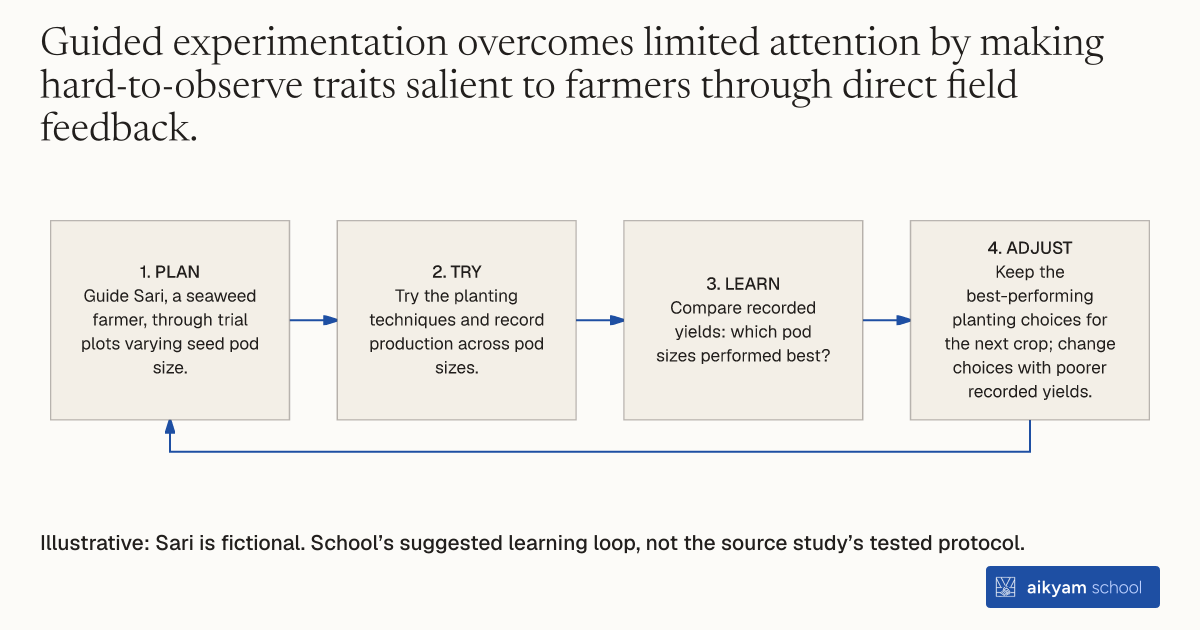
Try, learn and adjust
Use trial yields to review seed pod size
- Plan: Guide Sari, a seaweed farmer, through trial plots varying seed pod size.
- Try: Try the planting techniques and record production across pod sizes.
- Learn: Compare recorded yields: which pod sizes performed best?
- Adjust: Keep the best-performing planting choices for the next crop; change choices with poorer recorded yields.
Illustrative: Sari is fictional. School’s suggested learning loop, not the source study’s tested protocol.
See source →Observe pod size and production results. Do not assume a yield gain. School suggests this learning loop; it was not tested by the source.
How
When to use
Smallholder farmers frequently fail to optimize crop management because key productivity drivers are difficult to observe directly during routine farming. Behavioral biases and limited attention cause farmers to ignore subtle physical traits that significantly affect crop yields. This method uses structured farmer-led experimentation to draw attention to neglected production characteristics.
Guide smallholder farmers through structured hands-on experimentation to identify and optimize hard-to-observe crop traits.
- Extension officers conduct field surveys to identify overlooked physical traits that influence crop yields.
- Extension staff design structured experimentation protocols focusing on specific variable dimensions such as seed pod size.
- Extension workers introduce new planting techniques and guide farmers in conducting trial plots on their farms.
- Farmers record production results across different trait dimensions during crop growth cycles.
- Farmers adopt optimal planting techniques and seed pod dimensions based on observed experimental yields.
Why it works
Structured trials allow farmers to notice non-obvious relationships between management choices and crop yields.
Example
In Bali, Indonesia, seaweed-farmer-led experimentation highlighting new planting techniques led farmers to change their production methods and optimize seed pod size, a hard-to-observe trait that impacts crop yields.
About the study
Participants
Smallholder seaweed farming households in Bali, Indonesia.
Study Design
Randomized field trial evaluating farmer-led experimentation and information highlighting new planting techniques targeting seed pod size.
Results
Guided farmer-led experimentation and information on new planting techniques enabled seaweed farmers to change production methods and optimize seed pod size to improve yields.