Try, learn and adjust
Check craft-sector export readiness before selection
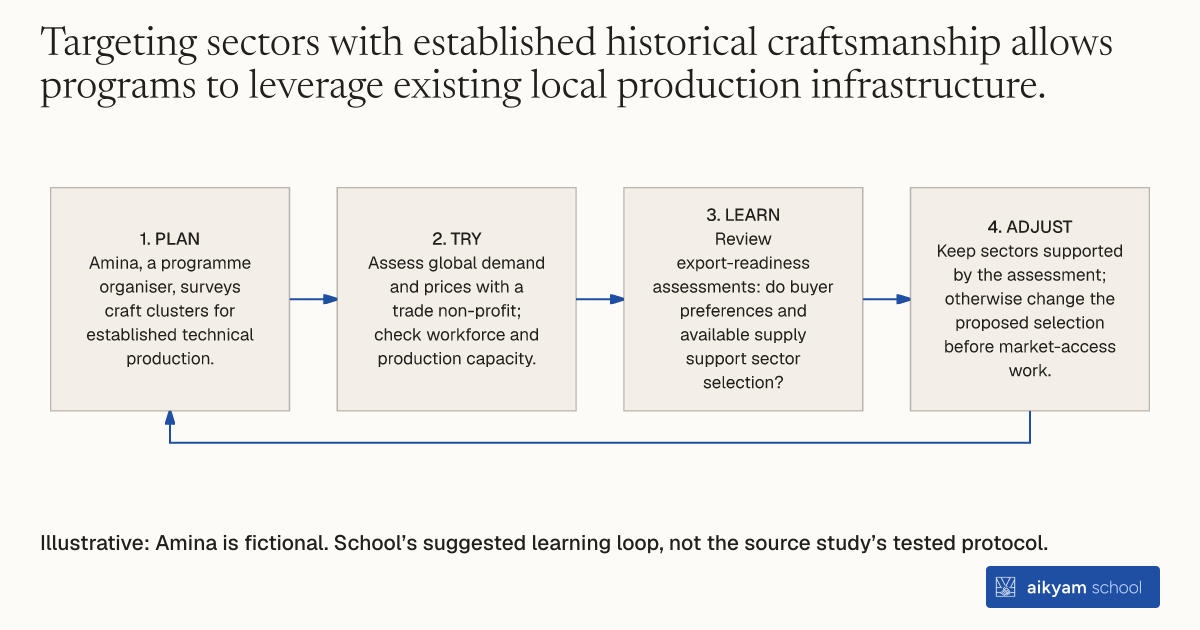
- Plan: Amina, a programme organiser, surveys craft clusters for established technical production.
- Try: Assess global demand and prices with a trade non-profit; check workforce and production capacity.
- Learn: Review export-readiness assessments: do buyer preferences and available supply support sector selection?
- Adjust: Keep sectors supported by the assessment; otherwise change the proposed selection before market-access work.
Illustrative: Amina is fictional. School’s suggested learning loop, not the source study’s tested protocol.
See source →School’s suggested, untested learning loop. Observe craft capability, buyer demand and supply capacity; sector selection alone does not establish export gains.
How
When to use
Small-scale craft producers in lower-income nations frequently face limited growth due to low domestic demand and prices. Development organizations need a structured way to select traditional manufacturing industries capable of competing in foreign markets. This approach identifies artisanal sectors that can sell competitive products to high-income international buyers.
Identify traditional artisanal manufacturing sectors that possess competitive market potential in foreign countries.
- Survey local craft clusters to identify historical manufacturing strongholds with concentrated technical production.
- Evaluate product categories against global consumer demand to determine if goods can be sold at competitive prices in high-income markets.
- Partner with international trade non-profits to assess export readiness and design potential for foreign buyers.
- Assess total country workforce and production volume in the sector to ensure adequate supply capacity.
Why it works
Matching these traditional crafts to foreign buyer preferences creates opportunities for higher prices and sustained enterprise growth.
Example
Aid to Artisans evaluated the Egyptian flat-weave rug cluster in Fowa, where 17,000 workers generated 7 percent of global carpet employment, identifying it as a sector capable of selling competitive goods to high-income buyers in the United States and Europe.
About the study
Participants
N = 219 eligible small rug-producing firms with fewer than 5 employees in Fowa, Egypt.
Study Design
Randomized Controlled Trial evaluating market access support across 74 treatment firms and 145 comparison firms from 2011 to 2014.
Results
Connecting selected rug firms to export markets increased monthly profits by 26 percent and unit prices by 43 percent relative to comparison firms.