Research design
Set pumping limits from initial use
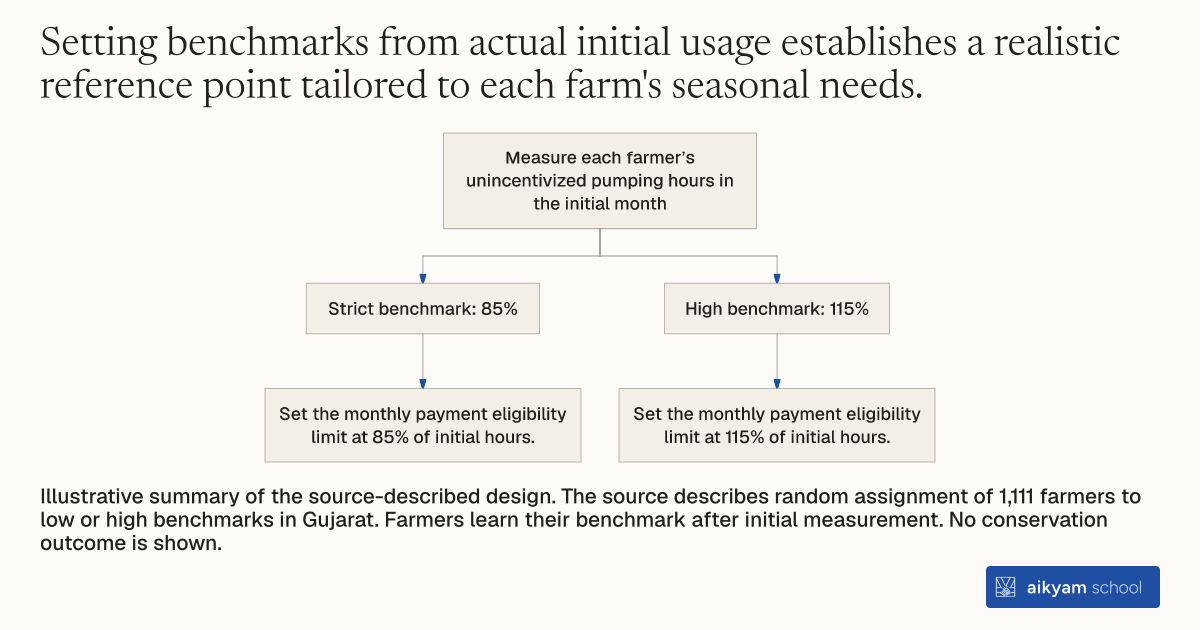
Measure each farmer’s unincentivized pumping hours in the initial month
- Strict benchmark: 85%
- Set the monthly payment eligibility limit at 85% of initial hours.
- High benchmark: 115%
- Set the monthly payment eligibility limit at 115% of initial hours.
Illustrative summary of the source-described design. The source describes random assignment of 1,111 farmers to low or high benchmarks in Gujarat. Farmers learn their benchmark after initial measurement. No conservation outcome is shown.
See source →How
When to use
Unregulated groundwater pumping depletes aquifers in semi-arid regions where energy for irrigation is heavily subsidized. Program managers designing financial conservation incentives face the challenge of establishing realistic usage baselines for each participant. This benchmarking method sets individual monthly pumping targets using unincentivized historical usage data to measure real water savings.
Establish individual monthly pumping benchmarks based on initial unincentivized usage to set conservation payment targets.
- Install hours-of-use meters on electric pump starters across participating farms.
- Monitor unincentivized agricultural groundwater pumping during the first month of the study to log baseline hours.
- Calculate an individual benchmark for each farmer equal to their total pumping hours recorded during that initial month.
- Inform farmers of their assigned benchmark quantity after the initial measurement period ends.
- Multiply the benchmark quantity by a target percentage multiplier, such as 85 percent for a strict benchmark or 115 percent for a high benchmark, to define monthly eligibility limits for conservation payments.
Why it works
Strict baseline limits improve program cost-effectiveness by preventing payments for non-additional conservation that would have occurred anyway.
Example
Researchers in Saurashtra, Gujarat, recorded baseline pumping hours during the first month across 1,111 smallholder farmers using starter meters. They randomly assigned farmers to either a strict low benchmark of 85 percent of initial pumping or a high benchmark of 115 percent. The low-benchmark group achieved both greater conservation and lower costs, with an average conservation cost less than half that of the high-benchmark group.
About the study
Participants
1,111 smallholder farmers (from a sampling frame of 1,347 farmers across 1,328 water-sharing pools, after 236 attrited) in Saurashtra, Gujarat, India.
Study Design
Randomized controlled trial comparing low-benchmark (85% of baseline hours) and high-benchmark (115% of baseline hours) payment groups, with pumping monitored monthly using starter meters from December 2022 to March 2023.
Results
The low-benchmark group achieved greater water conservation and lower total costs, with an average conservation cost less than half that of the high-benchmark group.