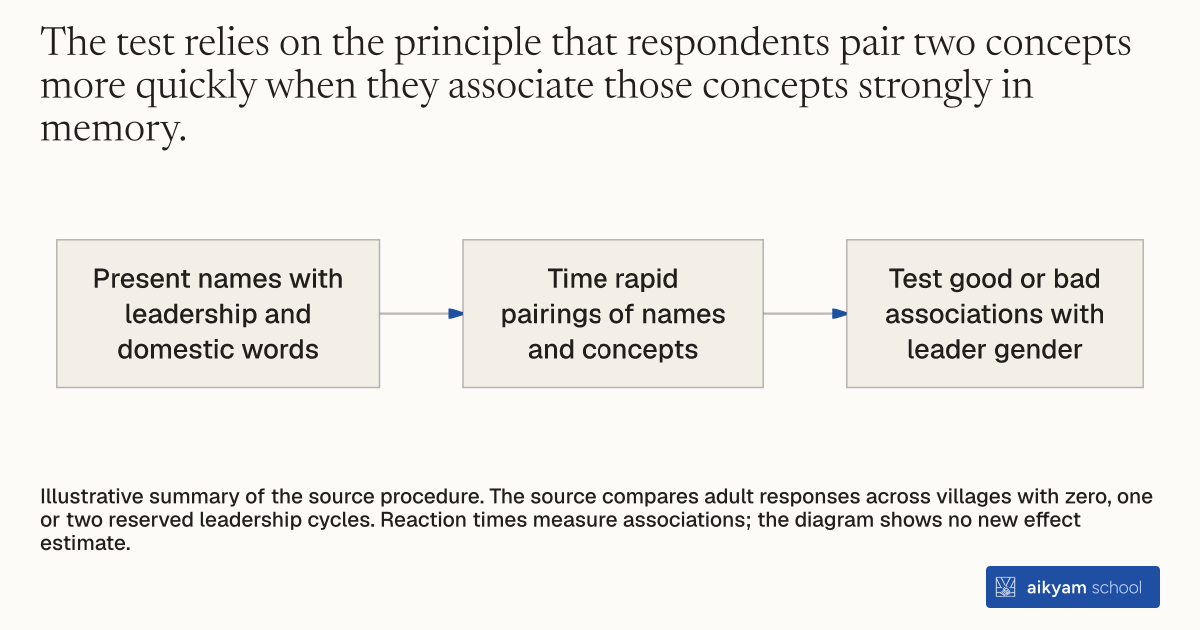
Research procedure
Measure rapid gender associations
- Present names with leadership and domestic words
- Time rapid pairings of names and concepts
- Test good or bad associations with leader gender
Illustrative summary of the source procedure. The source compares adult responses across villages with zero, one or two reserved leadership cycles. Reaction times measure associations; the diagram shows no new effect estimate.
See source →How
When to use
Researchers and policy evaluators need to assess implicit cognitive biases and stereotypes that direct self-reporting does not capture. Explicit survey questions often fail to reveal deep-seated gender associations due to social desirability bias or lack of conscious awareness. The Implicit Association Test measures rapid mental categorization speed to evaluate voters' subconscious associations between gender, leadership, and domestic tasks.
Administer a computer-based or rapid categorization task to measure subconscious mental associations between gender names and occupational roles.
- Surveyors set up a computer-based rapid categorization test for adult respondents in rural village councils.
- Enumerators present respondents with male and female names alongside leadership words and domestic task words.
- Test software prompts respondents to pair names and concepts under speeded conditions.
- Surveyors measure categorization reaction times to quantify gender-occupation stereotype strength.
- Evaluators test taste bias by measuring speed in associating male versus female leaders with good or bad concepts.
Why it works
Rapid categorization circumvents conscious filter mechanisms, revealing whether exposure to female leaders reduces subconscious gender-role stereotyping.
Example
In rural West Bengal, researchers administered an Implicit Association Test to villagers across 495 village councils to evaluate whether political exposure to female leaders altered subconscious associations between men and leadership activities.
About the study
Participants
Male and female adult respondents surveyed across 495 randomly selected rural villages in Birbhum district, West Bengal, India.
Study Design
Experimental categorization task comparing implicit associations across villages exposed to zero, one, or two cycles of mandated female political leadership.
Results
Exposure to a female leader significantly reduced male villagers' implicit association of leadership activities with men, while showing that all villagers exhibited an implicit same-gender preference.