Research steps
Measure choices about effort timing
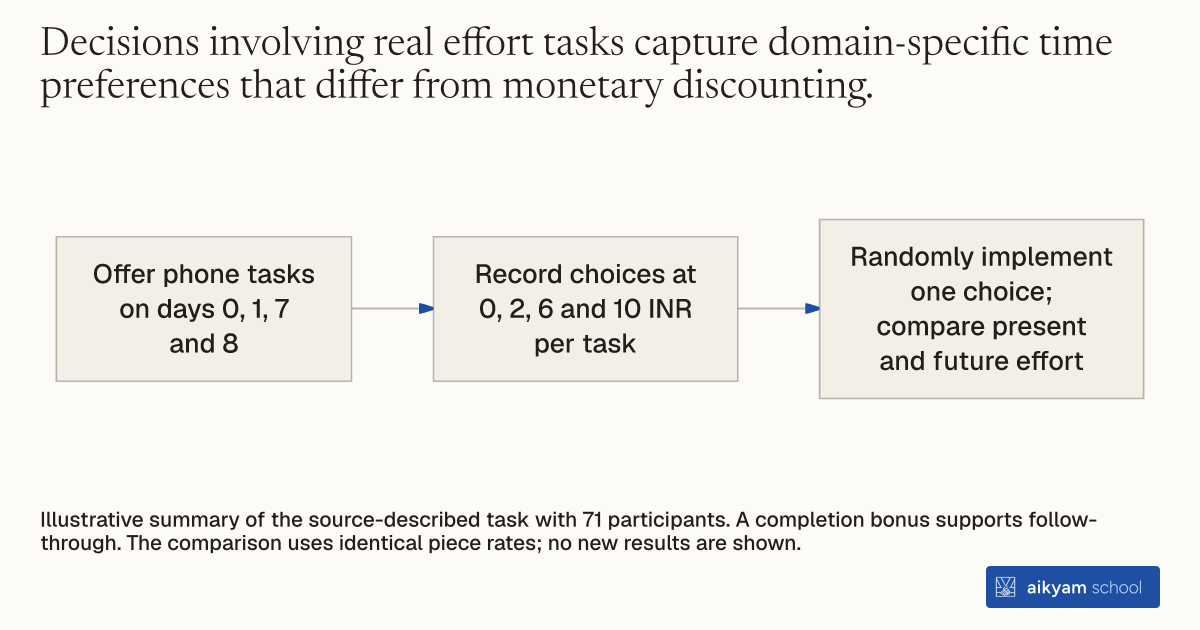
- Offer phone tasks on days 0, 1, 7 and 8
- Record choices at 0, 2, 6 and 10 INR per task
- Randomly implement one choice; compare present and future effort
Illustrative summary of the source-described task with 71 participants. A completion bonus supports follow-through. The comparison uses identical piece rates; no new results are shown.
See source →How
When to use
Behavioral research programs need to measure present bias and time discount factors specifically in the effort domain. Standard financial time discount measures fail to predict behavior for tasks with immediate physical effort costs. This method serves researchers and program designers evaluating effort impatience among field populations.
Measure time preferences over physical effort by requiring participants to allocate effort tasks across present and future dates at varying piece rates.
- Design a standardized real-effort task, such as calling an automated phone line to listen to a brief recording and answer a verification question.
- Present participants with choices on a survey day regarding how many tasks to complete across different dates, including present dates and future dates up to eight days later.
- Vary the offered piece rate across choices, ranging from 0 to 10 INR per completed task.
- Inform participants that one choice will be randomly selected for real-stakes implementation using the strategy method.
- Provide a completion bonus for completing all chosen tasks to ensure follow-through.
- Calculate the difference between tasks allocated to future dates versus the present date at identical piece rates to measure effort discounting and present bias.
Why it works
Eliciting choices across multiple dates and piece rates provides a structural and reduced-form measure of effort impatience that is robust to payment liquidity.
Example
Surveyors elicited intertemporal effort task choices from 71 community members in Coimbatore, India, to validate an impatience survey index. Participants chose to complete 13 percent fewer tasks in the present than on future dates across piece rates, with effort-impatient individuals allocating 1.3 more tasks to future dates than today.
About the study
Participants
71 participants in Coimbatore, India, demographic peers to the main experimental sample (average age 50, urban low-to-middle income).
Study Design
An incentivized field elicitation where participants made real-stakes choices allocating phone-call effort tasks across four dates (days 0, 1, 7, 8) at four piece rates (0, 2, 6, 10 INR), with one choice randomly implemented.
Results
Participants allocated 13 percent fewer tasks to the present than to future dates, yielding an estimated quasi-hyperbolic effort discount factor of 0.565, which was significantly lower than monetary discount factors ranging from 0.962 to 1.054.