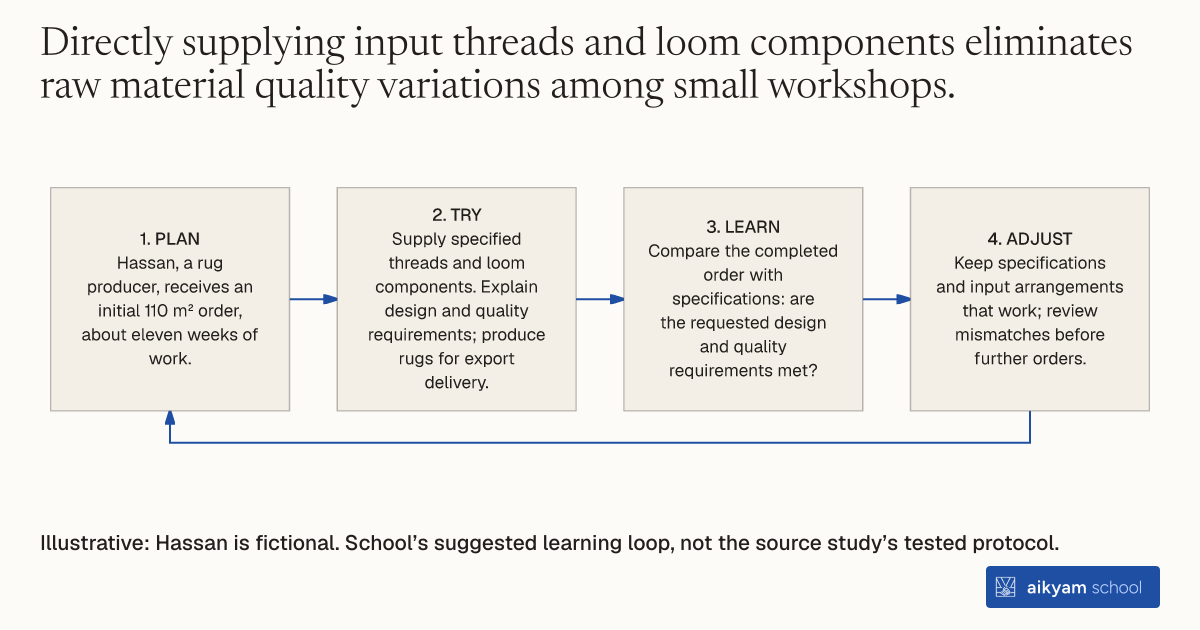
Try, learn and adjust
Check the first export order meets specifications
- Plan: Hassan, a rug producer, receives an initial 110 m² order, about eleven weeks of work.
- Try: Supply specified threads and loom components. Explain design and quality requirements; produce rugs for export delivery.
- Learn: Compare the completed order with specifications: are the requested design and quality requirements met?
- Adjust: Keep specifications and input arrangements that work; review mismatches before further orders.
Illustrative: Hassan is fictional. School’s suggested learning loop, not the source study’s tested protocol.
See source →School’s suggested loop, not a tested source procedure. Observe supplied materials and order conformity; do not assume the source’s profit gains.
How
When to use
Small-scale craft producers in lower-income regions struggle to enter global markets due to high entry barriers and inconsistent material inputs. Intermediaries require a reliable way to issue initial production contracts while ensuring raw input quality stays uniform across producers. This approach provides small firms with trial export orders, technical specifications, and standardized materials.
Provide micro-enterprises with initial export orders, standardized input materials, and clear product specifications to enable foreign market participation.
- Intermediaries visit eligible local firms to outline specific rug designs and explain that goods are destined for foreign high-income markets.
- Intermediaries issue an initial export order, such as 110 square meters of rug production, representing approximately eleven weeks of work.
- Intermediaries supply design-specific input threads, including warp and weft threads, and required loom components to ensure material consistency.
- Intermediaries share detailed technical specifications and quality standards required by international buyers.
- Firms manufacture the requested rugs while intermediaries coordinate export shipping and client delivery.
Why it works
Providing structured order volumes gives small firm owners the financial security and practice needed to adapt to foreign buyer standards.
Example
Hamis Carpets visited randomly selected small rug producers in Fowa, Egypt, providing them with initial orders of 110 m² of duble rugs along with design-specific input threads and loom components.
About the study
Participants
N = 219 eligible small rug producers (74 treatment, 145 comparison) with fewer than 5 employees in Fowa, Egypt.
Study Design
Randomized Controlled Trial evaluating market access support across 74 treatment firms receiving export orders and 145 comparison firms from 2011 to 2014.
Results
Offering initial export orders increased firm monthly profits by 26 percent and unit prices received by 43 percent relative to comparison firms.