Try, learn and adjust
Check university and extension representation
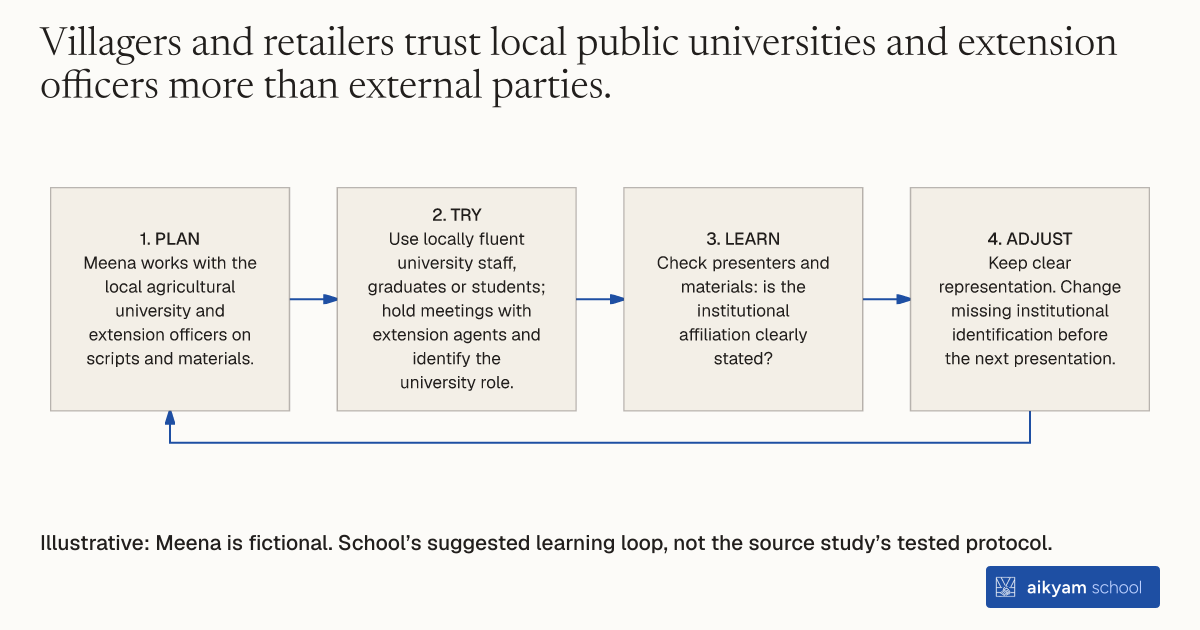
- Plan: Meena works with the local agricultural university and extension officers on scripts and materials.
- Try: Use locally fluent university staff, graduates or students; hold meetings with extension agents and identify the university role.
- Learn: Check presenters and materials: is the institutional affiliation clearly stated?
- Adjust: Keep clear representation. Change missing institutional identification before the next presentation.
Illustrative: Meena is fictional. School’s suggested learning loop, not the source study’s tested protocol.
See source →School’s suggested learning loop checks presenter identification, separately from the study’s institutional partnership; it does not isolate a branding effect.
How
When to use
Smallholder farmers and rural input sellers often distrust information provided by external researchers or unverified commercial sellers. Program managers use this method to partner visibly with established local public universities and agricultural extension officers when delivering technical market evidence.
Co-brand information campaigns with respected local public academic institutions and government extension staff to maximize institutional credibility.
- Partner with a local public agricultural university that holds an established regional reputation for research and extension.
- Involve university faculty and extension officers in designing intervention scripts and public presentation materials.
- Recruit university graduates and students fluent in local languages as field facilitators and enumerators.
- Conduct village meetings jointly with local government agricultural extension officers.
- Identify all field personnel as official representatives of the university when presenting test results to farmers and agro-dealers.
Why it works
Visibly associating extension activities with respected public institutions prevents skepticism and ensures participants accept verified technical findings.
Example
Researchers partnered with Sokoine University of Agriculture (SUA) and local government extension agents across Morogoro Region, Tanzania. Field teams composed of SUA staff and graduates delivered market posters and hosted village meetings. This institutional co-branding reduced farmer input quality concerns by 30% and increased urea adoption by 27%.
About the study
Participants
N = 995 farmers in 148 villages and N = 232 agro-dealers across 89 markets in Morogoro Region, Tanzania.
Study Design
Cluster-randomized controlled trial with visible institutional co-branding by Sokoine University of Agriculture faculty, students, and local government extension agents.
Results
Co-branded university and extension information meetings decreased farmer quality concerns by 0.595 bad quality bags out of 10 (a 30% reduction, p < 0.01) and increased the likelihood of urea fertiliser adoption by 10.6 percentage points (a 27% increase, p < 0.01).