Try, learn and adjust
Check the light-touch package reaches a household
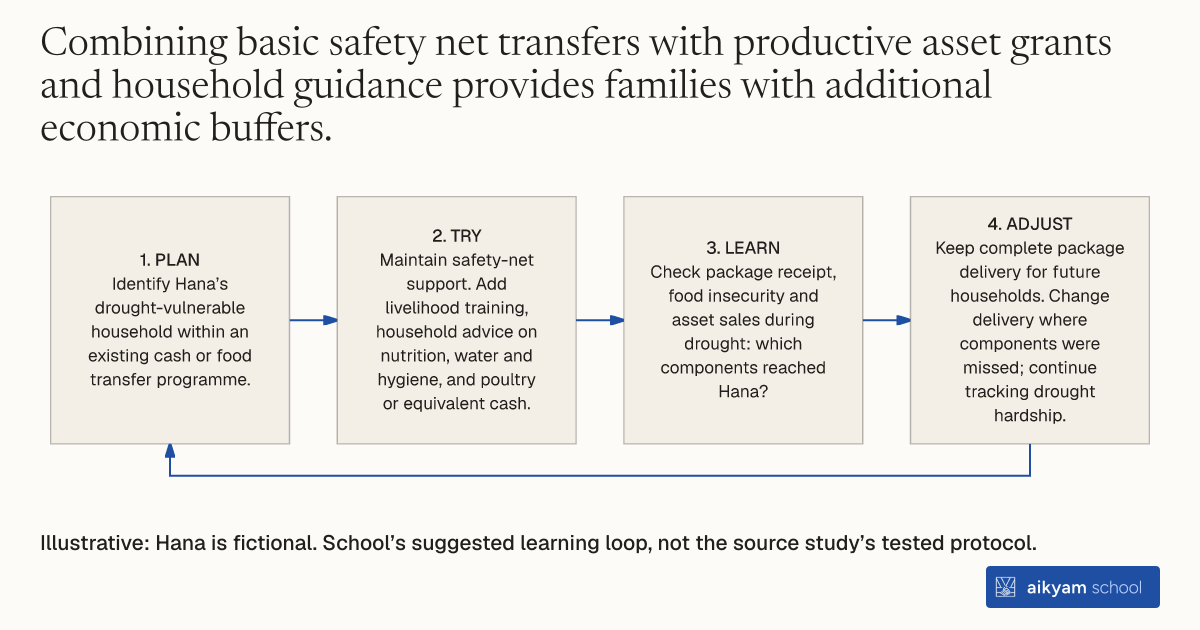
- Plan: Identify Hana’s drought-vulnerable household within an existing cash or food transfer programme.
- Try: Maintain safety-net support. Add livelihood training, household advice on nutrition, water and hygiene, and poultry or equivalent cash.
- Learn: Check package receipt, food insecurity and asset sales during drought: which components reached Hana?
- Adjust: Keep complete package delivery for future households. Change delivery where components were missed; continue tracking drought hardship.
Illustrative: Hana is fictional. School’s suggested learning loop, not the source study’s tested protocol.
See source →School’s suggested, untested loop. Observe package receipt, food insecurity and asset sales. The source reports no non-farm diversification where rural markets were absent.
How
When to use
Rural households in drought-vulnerable regions experience severe food insecurity during climatic shocks. Standalone social cash transfers may be insufficient to buffer families against food distress and asset liquidation when extreme weather hits. This approach targets rural households enrolled in social safety net programs to strengthen long-term shock absorption.
Provide a light-touch graduation package alongside regular social assistance cash or food transfers to drought-vulnerable households.
- Program administrators identify rural, drought-vulnerable households enrolled in existing cash or food transfer safety net programs.
- Program staff deliver livelihood training focused on income generation skills.
- Extension workers conduct household visits to deliver advice on nutrition, water, sanitation, and hygiene practices.
- Program staff disburse a lump-sum, in-kind transfer in the form of poultry or an equivalent cash amount to build household assets.
Why it works
Recipient households leverage these accumulated resources during severe droughts to sustain food intake and avoid selling core productive assets.
Example
In Ethiopia, researchers evaluated rural, drought-vulnerable households receiving cash or food transfers supplemented by a light-touch graduation model. When drought occurred, households receiving standalone cash transfers experienced a 36 percent increase in self-reported food insecurity compared to those offered the light-touch graduation package.
About the study
Participants
Rural, drought-vulnerable farming households in Ethiopia enrolled in a national social protection program.
Study Design
Randomized controlled trial (Hirvonen et al., 2023) comparing standalone cash or food transfers against cash or food transfers combined with a light-touch graduation model during drought events.
Results
During drought events, households receiving only preexisting cash or food transfers experienced a 36 percent increase in self-reported food insecurity compared to households receiving the light-touch graduation model. Graduation recipients maintained consumption and reduced asset sales, though income diversification into non-agricultural activities did not occur due to absent rural markets.