Try, learn and adjust
Check savings targets before paying the match
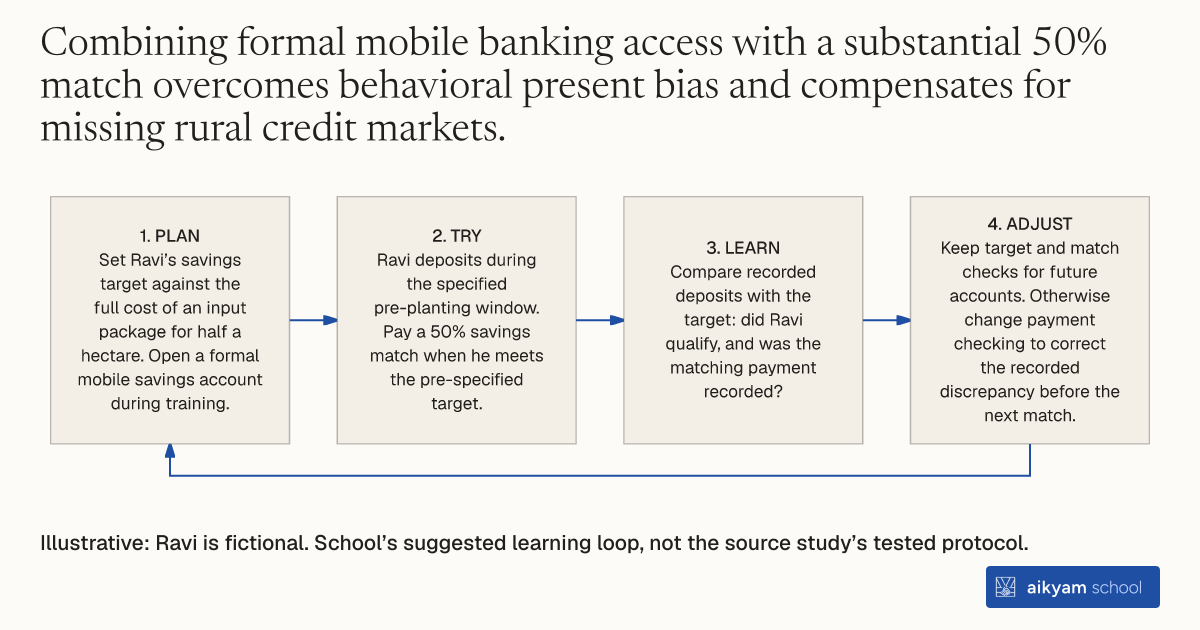
- Plan: Set Ravi’s savings target against the full cost of an input package for half a hectare. Open a formal mobile savings account during training.
- Try: Ravi deposits during the specified pre-planting window. Pay a 50% savings match when he meets the pre-specified target.
- Learn: Compare recorded deposits with the target: did Ravi qualify, and was the matching payment recorded?
- Adjust: Keep target and match checks for future accounts. Otherwise change payment checking to correct the recorded discrepancy before the next match.
Illustrative: Ravi is fictional. School’s suggested learning loop, not the source study’s tested protocol.
See source →School’s suggested learning loop, not a source-tested procedure. Observe the pre-specified target, savings deposits and 50% match; this check does not isolate long-term input adoption effects.
How
When to use
Temporary agricultural subsidies often fail to generate long-term input adoption because rural households lack formal savings mechanisms to accumulate cash for subsequent planting seasons. After subsidies expire, smallholders struggle to self-finance modern seeds and fertilizer. This method incentivizes rural farmers to build formal financial reserves by providing a 50% financial match on savings targets calibrated to future input costs.
Provide a 50% financial match on formal savings accounts to encourage smallholder farmers to save for upcoming agricultural input purchases.
- Partner with a commercial microfinance bank that offers mobile banking services in rural farming communities.
- Calculate a target savings amount equal to the full market cost of an improved seed and fertilizer package for a half-hectare plot.
- Enroll smallholder farmers into formal mobile banking savings accounts during financial literacy training sessions.
- Establish a pre-specified savings window prior to the next planting season during which farmers deposit cash into their accounts.
- Deposit a 50% financial match into each farmer's account once they meet their pre-specified agricultural savings target.
Why it works
The financial reward incentivizes farmers to accumulate liquidity, extending their psychological planning horizons and enabling self-financed input purchases.
Example
In Manica Province, Mozambique, researchers collaborated with Opportunity Bank of Mozambique to offer a matched savings program to maize producers. The program assigned 485 smallholders (245 voucher winners and 240 voucher losers) across 75 villages to receive a 50% savings match if they met a savings target calibrated to the cost of a maize input package. The match led to large increases in formal savings deposits and lengthened farmers' psychological planning time horizons.
About the study
Participants
N = 485 smallholder maize producers (245 voucher lottery winners, 240 voucher lottery losers; 84% male, 76% literate) in Manica Province, Mozambique.
Study Design
Multi-dimensional Randomized Controlled Trial (RCT) testing a 50% savings match intervention cross-cut with a 50% input voucher coupon lottery.
Results
The 50% matched savings intervention led to large, statistically significant increases in formal savings deposits and lengthened farmers' psychological planning time horizons, with the largest increases in patience observed among poorer beneficiaries.