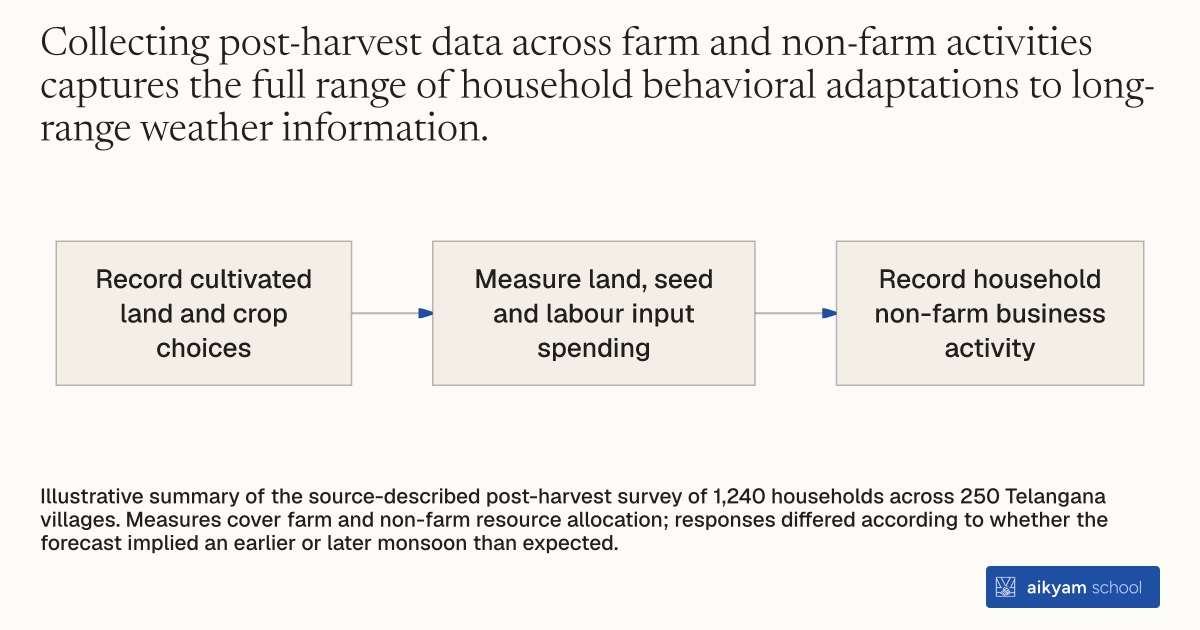
Research steps
Measure farm and non-farm choices after harvest
- Record cultivated land and crop choices
- Measure land, seed and labour input spending
- Record household non-farm business activity
Illustrative summary of the source-described post-harvest survey of 1,240 households across 250 Telangana villages. Measures cover farm and non-farm resource allocation; responses differed according to whether the forecast implied an earlier or later monsoon than expected.
See source →How
When to use
Farmers adjust agricultural inputs and non-farm economic activities based on updated weather expectations. Tracking both farm investments and off-farm business choices after forecast delivery reveals how information shifts total household economic strategies. Post-harvest surveys capture how forecast recipients reallocate capital and labor across agricultural and non-agricultural sectors.
Measure farm input changes and non-farm business operations across survey households after the agricultural harvest.
- Survey farming households after the seasonal harvest to record land under cultivation.
- Track changes in crop selection, noting the probability of planting higher-value cash crops.
- Quantify agricultural input expenditures across land, seeds, and labor using a standardized investment index.
- Record household non-farm business operations to assess off-farm labor and capital reallocation.
Why it works
This comprehensive measurement accounts for how farmers hedge agricultural risks by shifting resources into or out of off-farm enterprises.
Example
Researchers collected endline investment data from 1,240 households across 250 villages in Telangana, India. Farmers who learned the monsoon would be later than expected reduced cultivated land by 22 percent and increased non-farm business operations by 42 percent, while those expecting a better season increased land cultivation by 21 percent and decreased business operations by 35 percent.
About the study
Participants
1,240 farming households across 250 villages in Telangana, India.
Study Design
Post-harvest household survey during a Randomized Controlled Trial (RCT) evaluating seasonal forecast delivery against comparison villages.
Results
Farmers told the monsoon would be later reduced land under cultivation by 22 percent, were 31 percent less likely to add crops, reduced input investment by 0.08 SD, and increased non-farm business operations by 42 percent; farmers told the monsoon would be earlier increased land cultivation by 21 percent, were 36 percent more likely to grow cash crops, increased input investment by 0.31 SD, and decreased business operations by 35 percent.