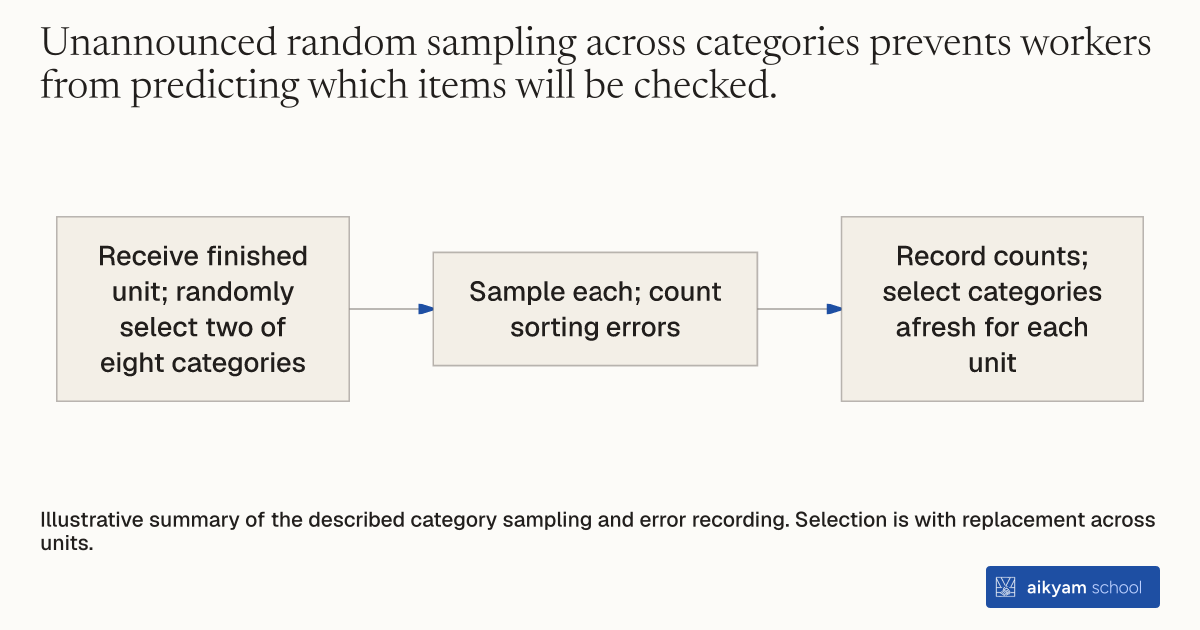
Research procedure
Sample sorting errors
- Receive finished unit; randomly select two of eight categories
- Sample each; count sorting errors
- Record counts; select categories afresh for each unit
Illustrative summary of the described category sampling and error recording. Selection is with replacement across units.
See source →How
When to use
Employers paying piece rates face difficulty measuring work quality when full inspections are too time-consuming. Workers who sort agricultural products may increase output speed while ignoring defects. Randomized spot-sampling allows managers to evaluate output quality accurately without inspecting every item.
Measure output quality in multi-category sorting tasks by drawing random category spot samples from each finished unit.
- Receive each completed unit of sorted output from the worker at the evaluation area.
- Select two product categories at random out of the eight sorted categories.
- Draw a small handful sample of sorted items from each of the two selected categories.
- Count the number of sorting errors, including miscategorized items, rotten items, or foreign materials, in each sample.
- Record the error count for each checked category as the unit's quality score.
- Re-randomize the category selection with replacement for every subsequent unit presented by the worker.
Why it works
Measuring errors systematically gives managers an objective quality metric while keeping inspection costs manageable.
Example
Field researchers in rural Malawi measured bean sorting quality across 612 contracted laborers sorting mixed beans into eight categories. Evaluators randomly sampled handfuls from two categories per unit, recording an average baseline error rate of 1.88 errors per unit.
About the study
Participants
612 contracted workers across 1,461 worker-day observations in 12 villages in rural Malawi (66.5% female, mean age 34.9 years).
Study Design
Randomized sampling of two randomly selected categories out of eight per unit sorted, recording error counts per unit across monitored and unmonitored conditions.
Results
Quality monitoring reduced sorting errors from a baseline average of 2.22 errors per unit without monitoring to 1.56 errors per unit with monitoring (a reduction of 0.561 to 0.744 errors per unit, p < 0.01).