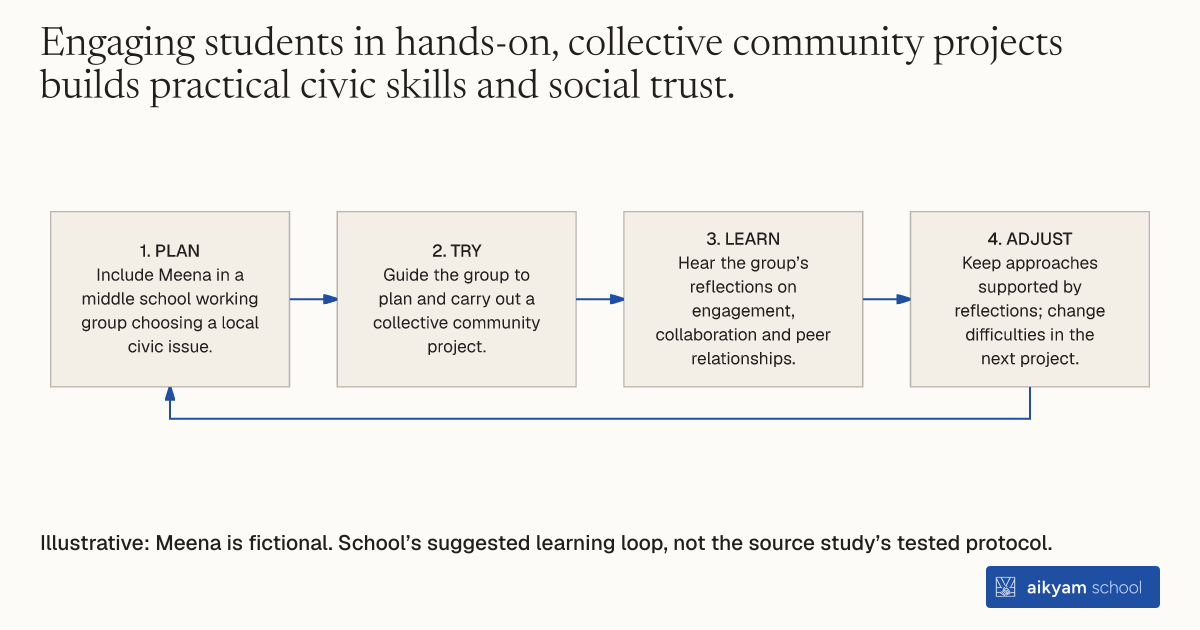
Try, learn and adjust
Check students reflect on their community project
- Plan: Include Meena in a middle school working group choosing a local civic issue.
- Try: Guide the group to plan and carry out a collective community project.
- Learn: Hear the group’s reflections on engagement, collaboration and peer relationships.
- Adjust: Keep approaches supported by reflections; change difficulties in the next project.
Illustrative: Meena is fictional. School’s suggested learning loop, not the source study’s tested protocol.
See source →Project participation and group reflections; no assumed change in civic skills. School’s suggested learning loop, not a source-tested cycle.
How
When to use
Middle school students lack early civic skills, political self-efficacy, and opportunities for positive social engagement. Traditional classroom instruction does not give young citizens practical experience with local problem-solving. This method helps schools and educators build civic virtues and collaborative skills in young students.
Implement a middle school civic education program where students design and execute collective citizenship projects in local communities.
- Integrate experiential civic education modules into middle school curricula.
- Form student working groups within middle school classrooms.
- Guide student groups to identify social or civic issues in their local communities.
- Assist students in planning and executing collective community projects to address chosen issues.
- Facilitate group reflection sessions on civic engagement, team collaboration, and peer relationships.
Why it works
Active participation strengthens students' confidence in their ability to influence political and social outcomes.
Example
In middle schools across three European countries, educators implemented a civic education program where students carried out collective citizenship projects, which increased students' altruism, political self-efficacy, and relationships with peers.
About the study
Participants
Middle school students across three European countries.
Study Design
School-based experimental study evaluating a civic education program featuring collective community projects.
Results
Increased students' altruism, political self-efficacy, and relationships with their peers.