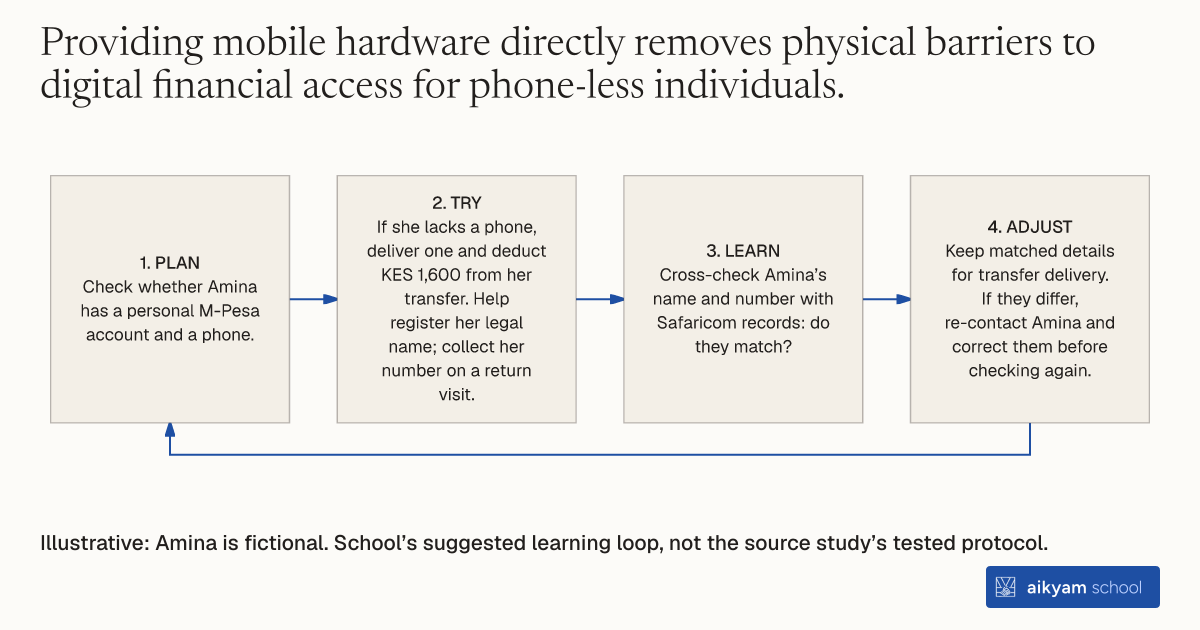
Try, learn and adjust
Check mobile money account details match
- Plan: Check whether Amina has a personal M-Pesa account and a phone.
- Try: If she lacks a phone, deliver one and deduct KES 1,600 from her transfer. Help register her legal name; collect her number on a return visit.
- Learn: Cross-check Amina’s name and number with Safaricom records: do they match?
- Adjust: Keep matched details for transfer delivery. If they differ, re-contact Amina and correct them before checking again.
Illustrative: Amina is fictional. School’s suggested learning loop, not the source study’s tested protocol.
See source →School’s suggested learning loop, not a source-tested procedure. Observe registered account names, phone numbers and resolved discrepancies; do not infer welfare effects from onboarding.
How
When to use
Digital cash transfer programs require recipients to have functional mobile phones and registered digital accounts, but many low-income individuals lack handsets or account registration. This method equips unbanked recipients with mobile hardware and assists them with account setup and identity verification. It serves anti-poverty programs distributing digital cash transfers in low-resource contexts.
Provide mobile handsets and guide unregistered recipients through account setup and identity verification to enable digital transfer delivery.
- Field officers verify whether each cash transfer recipient possesses an active personal M-Pesa account on the Safaricom network.
- Field officers deliver mobile phone handsets directly to the homes of recipients who do not own a phone.
- Field officers deduct the retail phone cost of KES 1,600 directly from the recipient's scheduled cash transfer.
- Field officers instruct recipients on setting up and registering an M-Pesa mobile money account under their official legal name.
- Field officers revisit recipients after initial setup to collect their registered mobile numbers and full legal names.
- Survey coordinators cross-check recipient names and phone numbers against Safaricom database records to confirm account registration.
- Field officers re-contact recipients to resolve any name or account discrepancies until mobile network records match recipient details.
Why it works
Formal identity cross-checking with the mobile network operator prevents payment errors and ensures funds reach the intended recipient securely.
Example
During cash transfer delivery in Nakuru County, Kenya, Busara Center field officers identified recipients who lacked M-Pesa accounts due to phone non-ownership. Officers delivered feature phones priced at KES 1,600, guided recipients through account registration, and cross-checked names with Safaricom records, enabling successful transfer delivery to 98.1 percent of cash transfer recipients.
About the study
Participants
5,756 low-income individuals across 233 rural villages in Nakuru County, Kenya, where 21 percent of participants were not registered on M-Pesa at baseline.
Study Design
A randomized controlled trial incorporating handset provision and M-Pesa account onboarding for unbanked recipients receiving USD 1,076 PPP unconditional cash transfers.
Results
Onboarding unbanked and phone-less households into mobile money enabled reliable delivery of USD 1,076 PPP cash transfers, resulting in a 20 percent increase in monthly consumption (USD 10.40 PPP), a 49 percent increase in asset holdings (USD 272.16 PPP), and 98.1 percent delivery compliance.