Try, learn and adjust
Check delivery of the graduation package
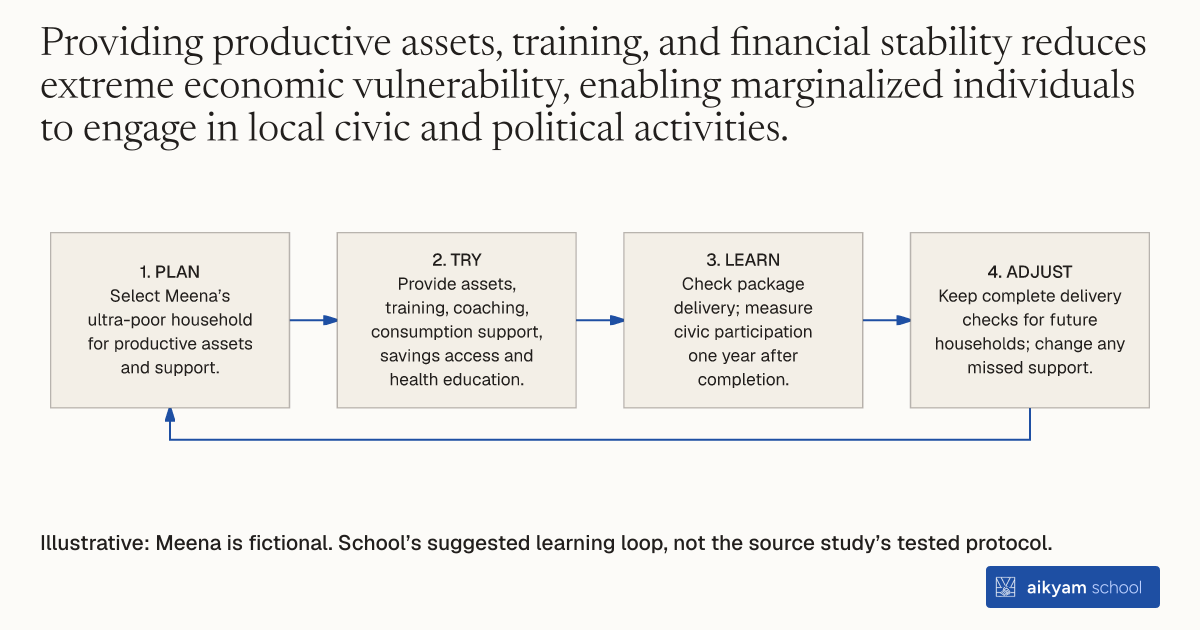
- Plan: Select Meena’s ultra-poor household for productive assets and support.
- Try: Provide assets, training, coaching, consumption support, savings access and health education.
- Learn: Check package delivery; measure civic participation one year after completion.
- Adjust: Keep complete delivery checks for future households; change any missed support.
Illustrative: Meena is fictional. School’s suggested learning loop, not the source study’s tested protocol.
See source →Package delivery and later civic participation. The reported gains excluded voting. School’s suggested learning loop, not a source-tested cycle.
How
When to use
Extremely poor households face severe economic marginalization that prevents them from participating in community leadership and civic life. Anti-poverty programs seek long-term civic integration alongside income gains. This method helps development organizations increase political engagement among the poorest citizens.
Deliver a multifaceted graduation program providing productive assets, training, and consumption support to households living in extreme poverty.
- Identify ultra-poor households across rural target communities.
- Provide participants with productive assets, such as livestock or microenterprise equipment.
- Deliver technical skills training and life skills coaching over a multi-month period.
- Supply regular consumption support to ensure basic food security during program inception.
- Facilitate access to savings accounts and health education.
- Measure participants' political involvement and civic participation one year post-program completion.
Example
Across six countries, a multifaceted graduation program targeting households living in extreme poverty increased participants' involvement in political activity one year later, with the exception of voting.
About the study
Participants
Ultra-poor households across six countries (Ethiopia, Ghana, Honduras, India, Pakistan, and Peru).
Study Design
Multi-country randomized controlled trial evaluating the long-term impacts of a comprehensive graduation intervention on economic and civic outcomes.
Results
Increased involvement in political activity one year later across six countries, though it did not increase voting turnout specifically.