Research design
Compare minimum prices with and without a fixed fee
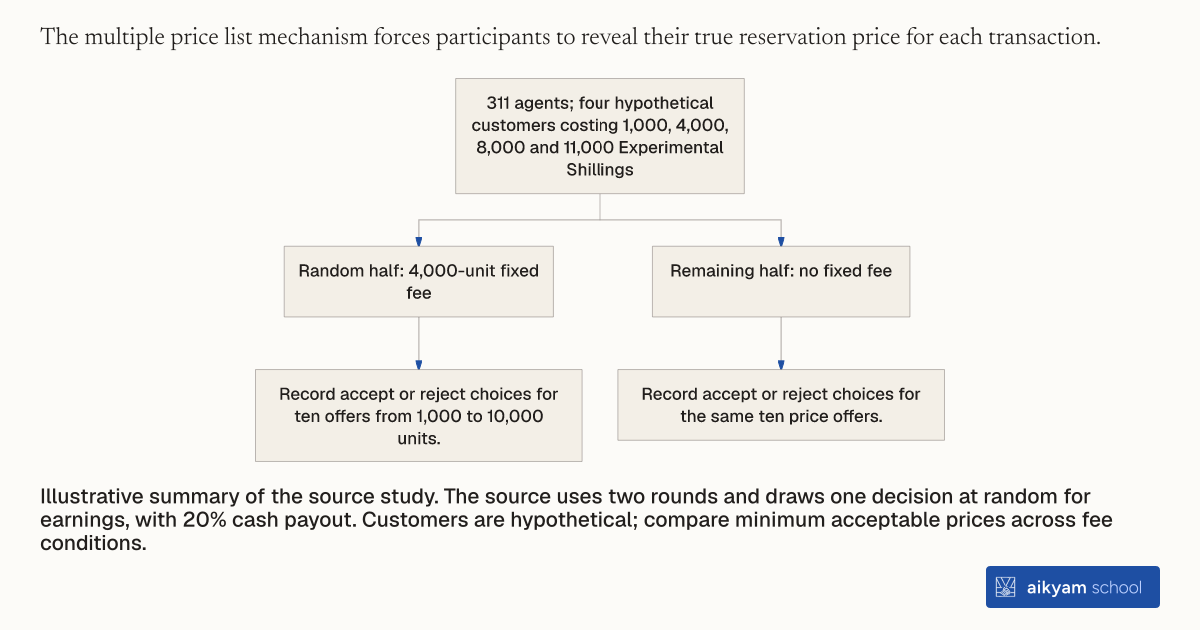
311 agents; four hypothetical customers costing 1,000, 4,000, 8,000 and 11,000 Experimental Shillings
- Random half: 4,000-unit fixed fee
- Record accept or reject choices for ten offers from 1,000 to 10,000 units.
- Remaining half: no fixed fee
- Record accept or reject choices for the same ten price offers.
Illustrative summary of the source study. The source uses two rounds and draws one decision at random for earnings, with 20% cash payout. Customers are hypothetical; compare minimum acceptable prices across fee conditions.
See source →How
When to use
Service providers often set fees using mental shortcuts rather than textbook profit rules. Evaluating whether providers base prices on marginal or average operating costs requires measuring their exact minimum acceptable prices under controlled cost changes. This method applies when testing provider pricing behavior in a lab setting.
Administer a multiple price list experiment with service providers to uncover minimum acceptable prices under varying fixed cost conditions.
- Assign individual providers to a visually isolated testing area paired with a trained research assistant.
- Present providers with four hypothetical customers assigned different marginal delivery costs of 1,000, 4,000, 8,000, and 11,000 experimental currency units.
- Randomly assign half the providers to pay a fixed operating fee of 4,000 units before serving customers, while the control group pays no fixed fee.
- Show providers ten sequential price offers ranging from 1,000 to 10,000 units for each customer on a game sheet.
- Record whether providers accept or reject each price offer to find the lowest price where they agree to deliver service.
- Place paper slips representing each decision in a bowl and draw one slip at random to determine final cash earnings.
Why it works
Testing choices with and without a fixed overhead fee proves whether providers calculate markups over average operating costs rather than marginal costs.
Example
Researchers conducted a lab-in-the-field experiment with 311 public livestock extension agents from 14 districts in Tanzania. Agents made customer service decisions under a multiple price list with and without a 4,000 Experimental Shillings fixed fee. Imposing the fixed fee increased total reservation prices across all customers by 3,678 Experimental Shillings, proving that agents set prices based on average operating costs.
About the study
Participants
311 government livestock extension agents from 14 randomly selected districts in Tanzania, each playing two experimental rounds.
Study Design
Randomized lab-in-the-field experiment employing a multiple price list mechanism with four hypothetical customers (marginal costs 1,000 to 11,000 Experimental Shillings), testing a 4,000 Experimental Shillings fixed cost treatment against a zero fixed cost control with 20% cash payout.
Results
The 4,000 Experimental Shillings fixed cost treatment increased participants' reservation prices for all customers combined by 3,678 Experimental Shillings (p < 0.01). The price increase was concentrated on low-marginal-cost customers, raising reservation prices for the first customer by 2,530 Experimental Shillings (p < 0.01) and the second customer by 831.6 Experimental Shillings (p < 0.01), confirming average-cost pricing behavior.