Try, learn and adjust
Check a one-time asset transfer reaches the household
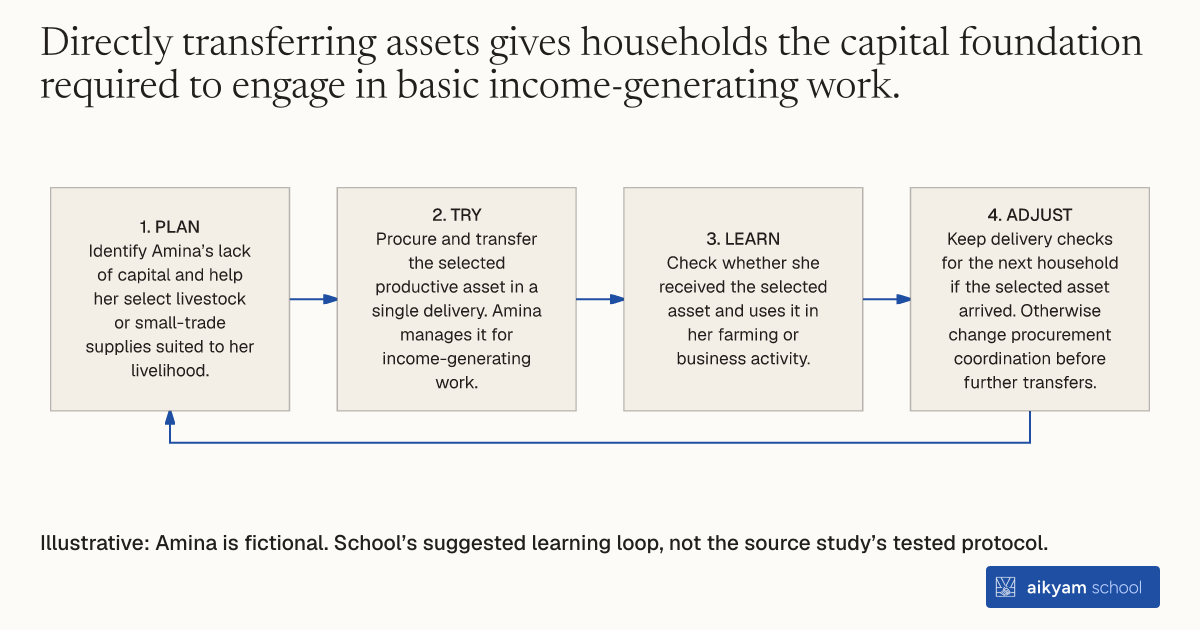
- Plan: Identify Amina’s lack of capital and help her select livestock or small-trade supplies suited to her livelihood.
- Try: Procure and transfer the selected productive asset in a single delivery. Amina manages it for income-generating work.
- Learn: Check whether she received the selected asset and uses it in her farming or business activity.
- Adjust: Keep delivery checks for the next household if the selected asset arrived. Otherwise change procurement coordination before further transfers.
Illustrative: Amina is fictional. School’s suggested learning loop, not the source study’s tested protocol.
See source →School’s suggested learning loop: observe receipt and use of the one-time asset; asset-only support may not reproduce the full programme’s lasting gains.
How
When to use
Low-income households in extreme poverty lack the capital needed to start self-employment activities. Providing capital goods helps ultra-poor families transition away from insecure casual labor. Transferring assets offers a direct way to build a household's economic foundation.
Provide ultra-poor households with a direct capital transfer in the form of productive assets or business supplies.
- Program managers identify low-income households that lack financial capital and productive assets.
- Field staff assist participants in selecting an appropriate asset such as livestock or trade inventory.
- Implementation teams procure and transfer the selected asset directly to the beneficiary in a single delivery.
- Program staff allow recipients to manage the asset to generate income through small business or farming activities.
Why it works
However, receiving assets alone without complementary training, coaching, or cash support often fails to deliver lasting impact over time.
Example
In Ghana, an evaluation gave ultra-poor participants a productive asset like a goat, but receiving the asset alone was insufficient to replicate the full program's long-term gains.