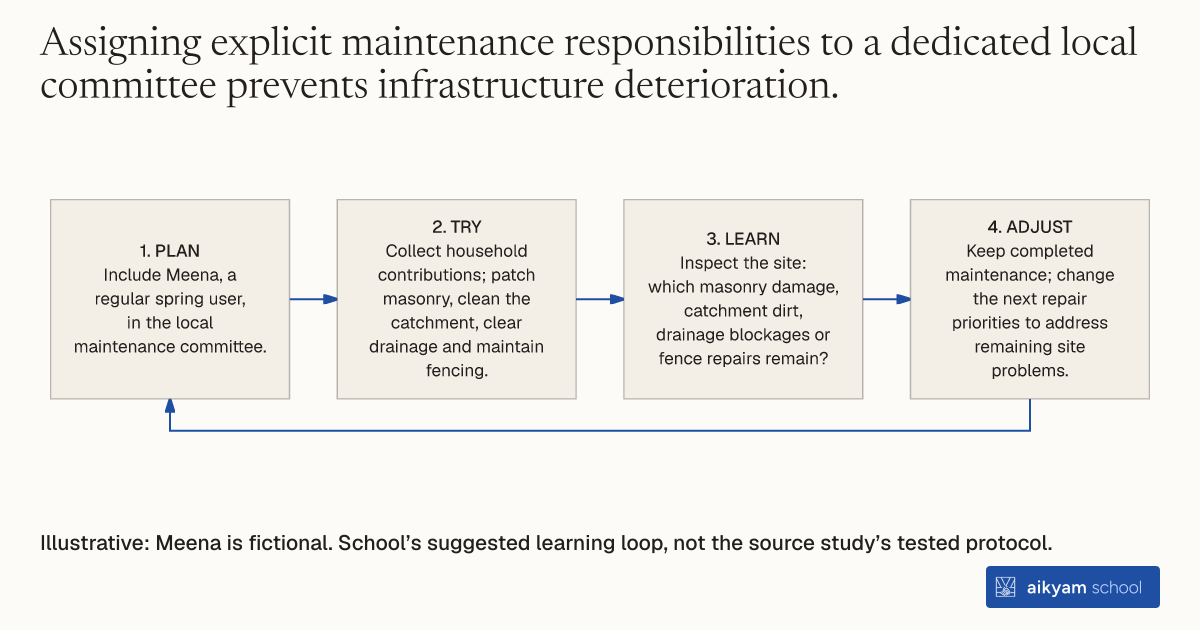
Try, learn and adjust
Check routine spring maintenance
- Plan: Include Meena, a regular spring user, in the local maintenance committee.
- Try: Collect household contributions; patch masonry, clean the catchment, clear drainage and maintain fencing.
- Learn: Inspect the site: which masonry damage, catchment dirt, drainage blockages or fence repairs remain?
- Adjust: Keep completed maintenance; change the next repair priorities to address remaining site problems.
Illustrative: Meena is fictional. School’s suggested learning loop, not the source study’s tested protocol.
See source →School’s suggested learning loop, not a tested protocol. Observe masonry, catchment cleanliness, drainage and fencing. Annual maintenance expenses average US$32.
How
When to use
In rural communities, newly constructed water infrastructure degrades without local ongoing upkeep. Establishing dedicated user committees assigns explicit management responsibility to community members. This ensures routine maintenance occurs without depending on constant external agency intervention.
Organize a local water user committee to perform routine maintenance and fund ongoing repairs.
- Project staff form a user maintenance committee among households designated as regular spring users.
- Committee members collect local contributions from user households to cover annual maintenance expenses averaging 32 US dollars per year.
- Committee members perform simple concrete patching on damaged masonry structures as needed.
- Committee members routinely clean the water catchment area to prevent contamination.
- Committee members clear drainage ditches and maintain perimeter fencing around the spring site.
Why it works
Organized community oversight leads to cleaner spring environments, intact perimeter fencing, and functional drainage systems.
Example
In Busia and Butere-Mumias districts of western Kenya, the non-governmental organisation International Child Support organized user maintenance committees across 184 protected springs to oversee routine repairs costing roughly 32 US dollars per year.
About the study
Participants
184 viable springs and 1,354 households across Busia and Butere-Mumias districts in Western Province, Kenya.
Study Design
Randomized evaluation over four years comparing protected springs managed by user committees against unprotected comparison springs.
Results
Protected springs with committees achieved 66% lower E. coli source contamination, significantly clearer water, better fencing and drainage, and less fecal matter and brush in the vicinity.