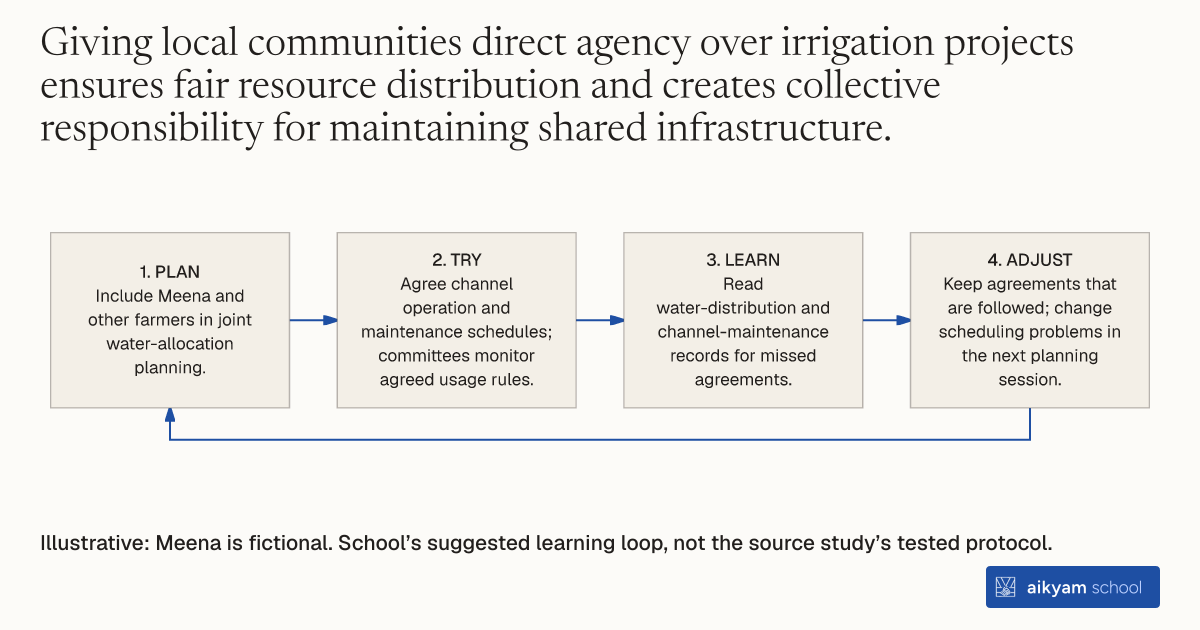
Try, learn and adjust
Check irrigation follows community agreements
- Plan: Include Meena and other farmers in joint water-allocation planning.
- Try: Agree channel operation and maintenance schedules; committees monitor agreed usage rules.
- Learn: Read water-distribution and channel-maintenance records for missed agreements.
- Adjust: Keep agreements that are followed; change scheduling problems in the next planning session.
Illustrative: Meena is fictional. School’s suggested learning loop, not the source study’s tested protocol.
See source →Water distribution, maintenance and conflicts. The evaluation is ongoing; no improvements are established. School’s suggested learning loop, not a source-tested cycle.
How
When to use
In agricultural regions facing climate volatility, top-down irrigation schemes often fail to allocate water efficiently or maintain infrastructure. Uncoordinated water extraction leads to local resource depletion and disputes among local farmers. This method applies to rural development agencies seeking to improve sustainable water allocation and reduce local conflicts.
Engage local agricultural communities directly in designing and implementing climate-adaptive irrigation projects.
- Rural development officers organize local farm communities across agricultural regions.
- Officers facilitate participatory planning sessions where farmers jointly determine water allocation rules.
- Community members establish shared schedules for operating and maintaining local irrigation channels.
- Local farming committees monitor water distribution and enforce agreed resource usage standards.
- Program staff track agricultural yields, channel maintenance, and social cohesion across participating villages in India.
Why it works
Participatory decision-making resolves water allocation disputes locally before they escalate into open intragroup conflict.
Example
In India, researchers evaluated the impact of community participation in implementing climate-adaptive irrigation projects on water allocation, channel maintenance, and intragroup conflicts.
About the study
Participants
Farmers and agricultural communities in India.
Study Design
Randomized controlled trial evaluating community participation in implementing climate-adaptive irrigation projects.
Results
Ongoing randomized evaluation examining the impacts of participatory agricultural transformation on water allocation, sustainable resource use, agricultural outcomes, channel maintenance, and intragroup conflict incidence.