Try, learn and adjust
Check weekly commission deductions
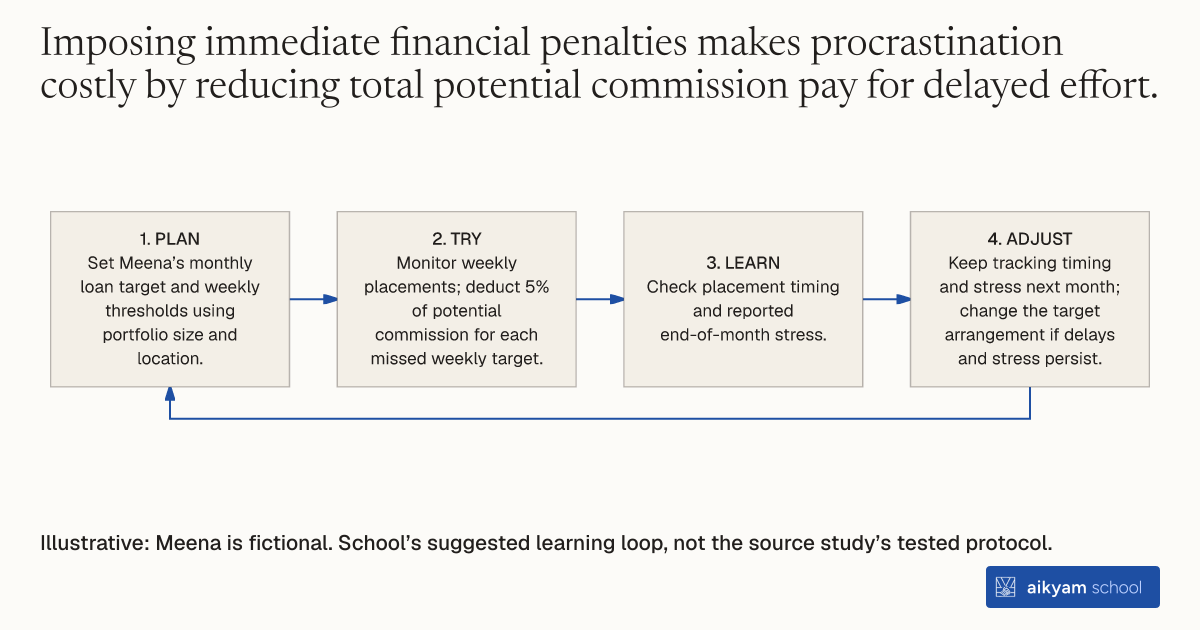
- Plan: Set Meena’s monthly loan target and weekly thresholds using portfolio size and location.
- Try: Monitor weekly placements; deduct 5% of potential commission for each missed weekly target.
- Learn: Check placement timing and reported end-of-month stress.
- Adjust: Keep tracking timing and stress next month; change the target arrangement if delays and stress persist.
Illustrative: Meena is fictional. School’s suggested learning loop, not the source study’s tested protocol.
See source →School’s suggested, untested loop. Observe weekly placements, deductions and stress. Baseline records still showed loan placement concentrated late in the month.
How
When to use
Frontline staff under monthly sales quotas often postpone effort until late in the month, leading to uneven productivity. Organizations sometimes attempt to curb this behavior by imposing financial penalties or commission deductions for failing to meet intermediate weekly targets. This method applies to sales managers and microfinance institutions structuring variable pay systems for field officers.
Deduct a fixed percentage from employee sales commissions whenever weekly placement targets are not met during a monthly cycle.
- Bank administrators establish baseline monthly loan placement goals for each loan officer based on portfolio size and location.
- Managers break down monthly credit targets into specific weekly target thresholds designed to balance placement across the month.
- Operations staff monitor weekly loan placement numbers at the end of each work week.
- Program accountants calculate potential monthly commission pay based on overall sales performance and portfolio delinquency.
- Payroll administrators deduct 5 percent from an officer's potential commission for every week the officer fails to meet the weekly target.
Why it works
However, relying heavily on negative fines can demoralize employees without providing positive time-management support or progress feedback.
Example
In Colombia, Bancamía instituted a compensation rule where loan officers faced a 5 percent reduction in potential commissions for each week they failed to achieve weekly credit placement goals, yet 56 out of 61 branches still placed over 50 percent of their loans during the final two weeks of the month.
About the study
Participants
61 bank branches and 388 loan officers in Colombia managing an average portfolio of 500 loans each.
Study Design
Observational baseline analysis of bank administrative records from January to September 2008 prior to the implementation of positive behavioral nudges.
Results
Under the 5 percent weekly commission penalty system, loan officers placed only 15 percent of loans in week one compared to 32 percent in week four, with 60.3 percent of officers reporting very high stress during the final week of the month.