Try, learn and adjust
Check performance before follow-on orders
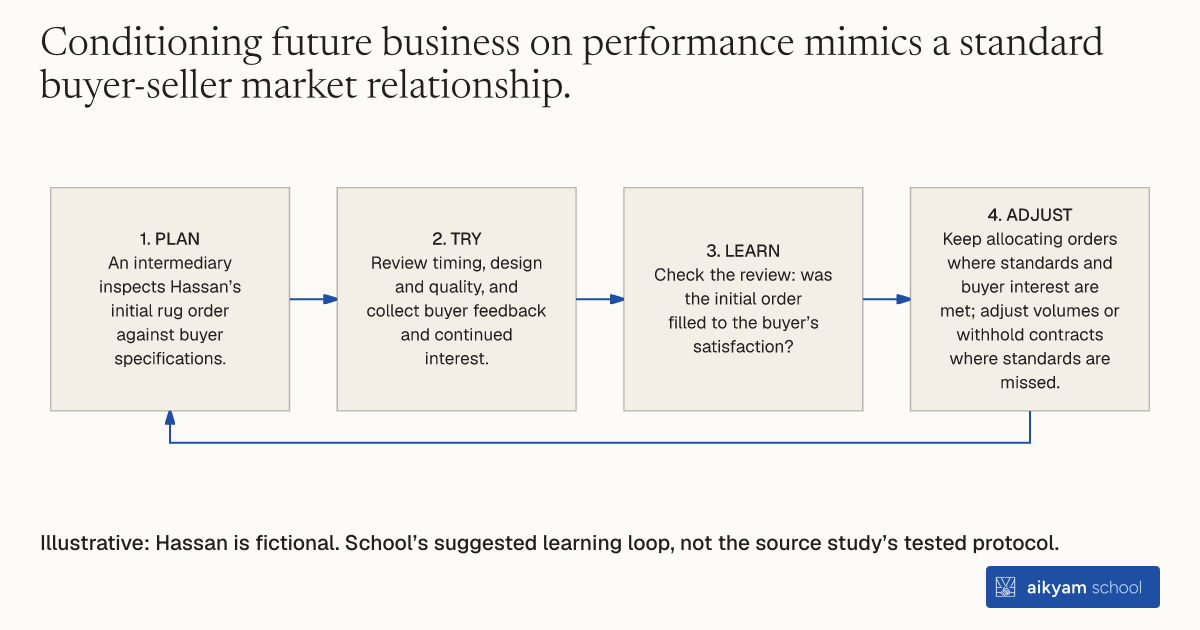
- Plan: An intermediary inspects Hassan’s initial rug order against buyer specifications.
- Try: Review timing, design and quality, and collect buyer feedback and continued interest.
- Learn: Check the review: was the initial order filled to the buyer’s satisfaction?
- Adjust: Keep allocating orders where standards and buyer interest are met; adjust volumes or withhold contracts where standards are missed.
Illustrative: Hassan is fictional. School’s suggested learning loop, not the source study’s tested protocol.
See source →School’s suggested loop, not a tested source procedure. Observe order fulfilment and buyer satisfaction; future order allocation is conditional.
How
When to use
Small-scale suppliers often receive equal trial opportunities regardless of execution quality. Intermediaries need an incentive mechanism to ensure foreign buyers receive high-quality products consistently while encouraging producers to maintain high standards. This approach allocates subsequent production orders based on firm performance and buyer satisfaction.
Allocate subsequent export orders to small producers based on prior manufacturing performance and buyer satisfaction.
- Intermediaries inspect initial completed order batches against buyer specifications.
- Intermediaries evaluate producer delivery timeliness, design accuracy, and overall product quality.
- Intermediaries collect continued order interest and feedback from international clients.
- Intermediaries assign additional export orders to high-performing firms that meet buyer standards.
- Intermediaries adjust order volumes or withhold follow-on contracts for firms that fail to meet quality thresholds.
Why it works
It motivates small producers to apply technical feedback and maintain quality standards on every order.
Example
Hamis Carpets placed subsequent export orders with small rug producers in Fowa, Egypt, based on how well initial 110 m² orders were filled and whether foreign buyers expressed continued interest.
About the study
Participants
N = 219 eligible small rug producers (74 treatment, 145 comparison) with fewer than 5 employees in Fowa, Egypt.
Study Design
Randomized Controlled Trial where 74 treatment firms received initial order requests, with subsequent orders conditioned on firm performance from 2011 to 2014.
Results
Exporting firms that maintained order fulfillment achieved a 26 percent increase in monthly profits and a 0.79 point higher quality score relative to comparison firms.