Research flow
Select the realised payout
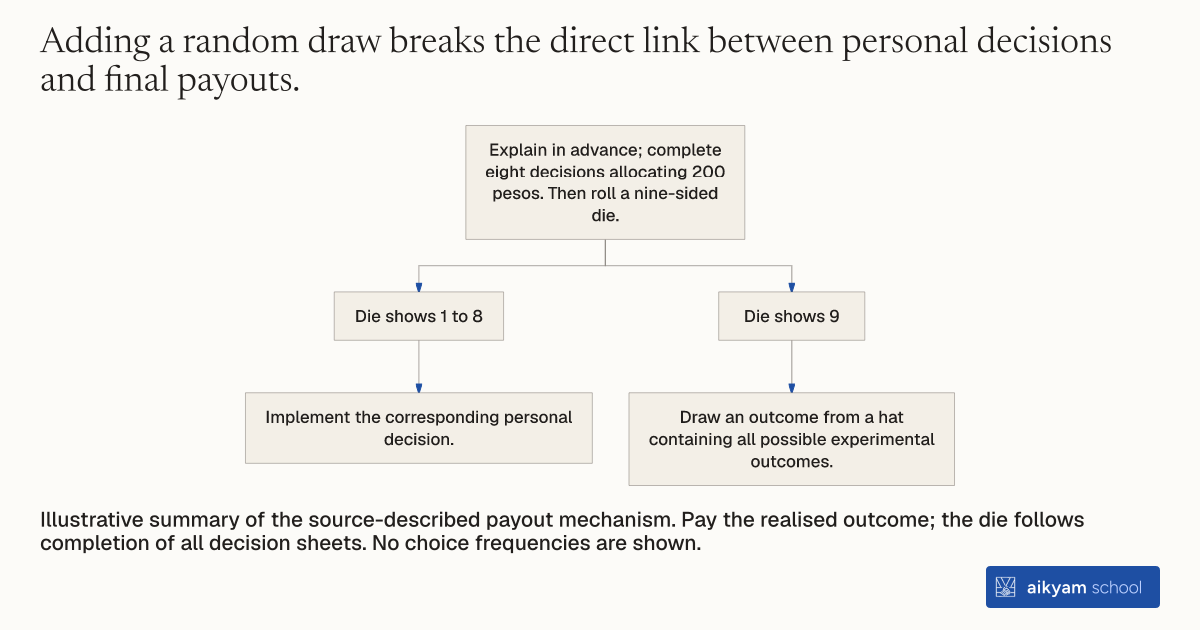
Explain in advance; complete eight decisions allocating 200 pesos. Then roll a nine-sided die.
- Die shows 1 to 8
- Implement the corresponding personal decision.
- Die shows 9
- Draw an outcome from a hat containing all possible experimental outcomes.
Illustrative summary of the source-described payout mechanism. Pay the realised outcome; the die follows completion of all decision sheets. No choice frequencies are shown.
See source →How
When to use
In experimental settings where subjects face spousal monitoring, complete information privacy is hard to maintain once participants return home. If a spouse observes the final payout, they can infer private choices and penalize the individual. This mechanism provides a randomized payout structure that gives participants plausible deniability regarding whether an outcome came from personal choice or random chance.
Obscure the connection between individual choices and final payouts using a nine-sided die roll and random hat draw.
- Present participants with eight separate decision scenarios allocating a 200 peso endowment.
- Inform participants in advance that one scenario or a random draw will be implemented at the end of the session.
- Roll a nine-sided die after participants complete all decision sheets.
- Implement the corresponding personal choice if the die lands on numbers one through eight.
- Require the participant to pick a random outcome out of a hat containing all possible experimental outcomes if the die lands on nine.
- Pay participants based on the realized outcome, allowing them to attribute payouts to bad luck rather than personal choice.
Why it works
This grants participants plausible deniability, protecting them from spousal punishment for hiding income or making non-conforming choices.
Example
Researchers tested 146 married couples at Green Bank in Mindanao, Philippines, using a nine-sided die roll payout mechanism. Under private conditions with plausible deniability, 52 percent of men deposited their 200 pesos into personal savings accounts rather than turning it over or spending it immediately.
About the study
Participants
146 married couples (291 individuals) recruited near Green Bank in Mindanao, Philippines, with average age of 43 and 19 years married.
Study Design
Randomized field experiment evaluating financial choices under Private, Public, and Negotiation conditions using a nine-sided die roll to determine final payouts.
Results
In Private with plausible deniability, 52 percent of men deposited 200 pesos into personal accounts compared to 23 percent in Public (p-value = 0.002). Men whose wives control savings were 55 percentage points more likely to deposit money into personal accounts in Private.