Try, learn and adjust
Check guard placement and security duties
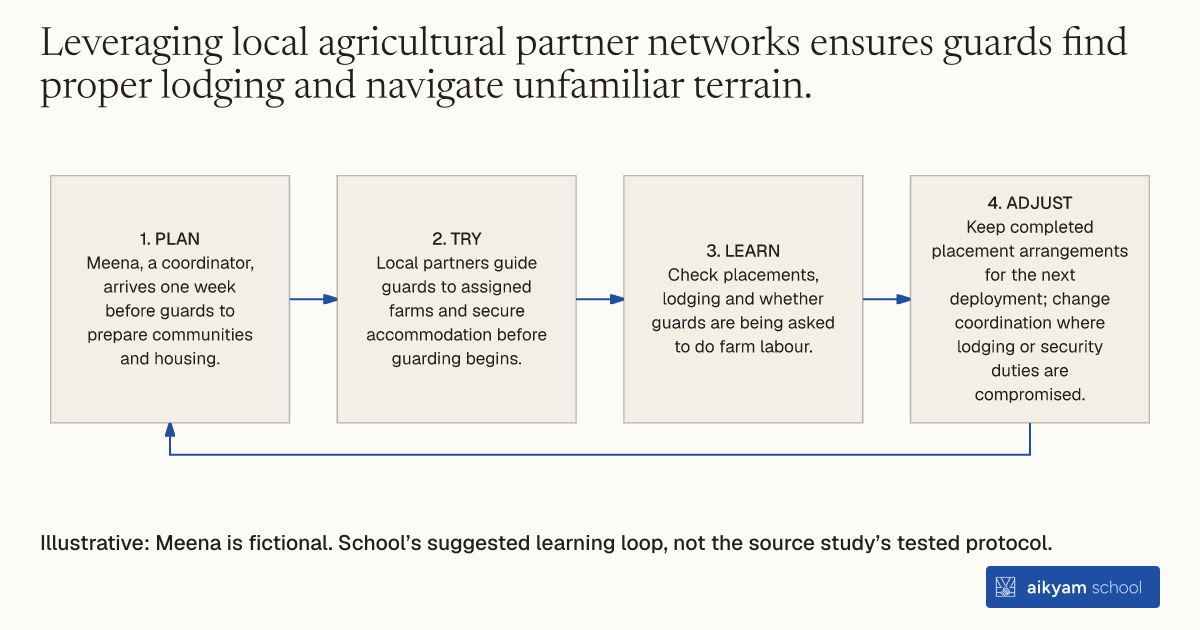
- Plan: Meena, a coordinator, arrives one week before guards to prepare communities and housing.
- Try: Local partners guide guards to assigned farms and secure accommodation before guarding begins.
- Learn: Check placements, lodging and whether guards are being asked to do farm labour.
- Adjust: Keep completed placement arrangements for the next deployment; change coordination where lodging or security duties are compromised.
Illustrative: Meena is fictional. School’s suggested learning loop, not the source study’s tested protocol.
See source →School’s suggested, untested loop. Observe placement, accommodation, routine check-ins and any diversion to farm labour.
How
When to use
Deploying outsider security personnel in rural agricultural communities creates severe placement and lodging challenges. Outsider guards may feel uncomfortable in unfamiliar areas or be diverted to non-security farm labor. This method establishes a structured multi-tier coordination network to lodge, deploy, and audit non-local guards effectively.
Establish a multi-level field coordination structure to deploy and manage outsider security guards across target farming communities.
- Deploy specialized cultural coordinators to target sub-counties one week prior to guard arrival to prepare host communities and arrange housing.
- Mobilize local partner networks, including village lead farmers and field coordinators, to guide incoming guards to assigned farming households.
- Assist all incoming outsider guards in securing suitable local village accommodation before guarding duties begin.
- Conduct routine check-ins through cultural coordinators to resolve minor guard issues and verify that guards perform strictly security work.
- Audit guard activities to ensure host farmers do not divert guards to non-security agricultural field labor.
Why it works
Continuous oversight by dedicated ethnic coordinators prevents guards from being misused as subsidized farm labor.
Example
Research teams deployed three Maasai coordinators a week early across 76 villages in Migori County, Kenya to assist incoming watchmen. The coordination network successfully placed guards with all matched households, secured local lodging, and ensured guards performed strictly security duties.
About the study
Participants
585 smallholding farmers across 76 villages in Suna East, Suna West, and Uriri sub-counties, Migori County, Kenya.
Study Design
Cluster-randomized field experiment backed by post-deployment watchman surveys to evaluate lodging success, duty compliance, and labor diversion.
Results
Pre-deployment coordination achieved 100% placement accuracy across treatment households, with survey auditing confirming watchmen performed strictly security work and avoided non-security farm labor.