Research pricing
Assign water discounts by scratch card
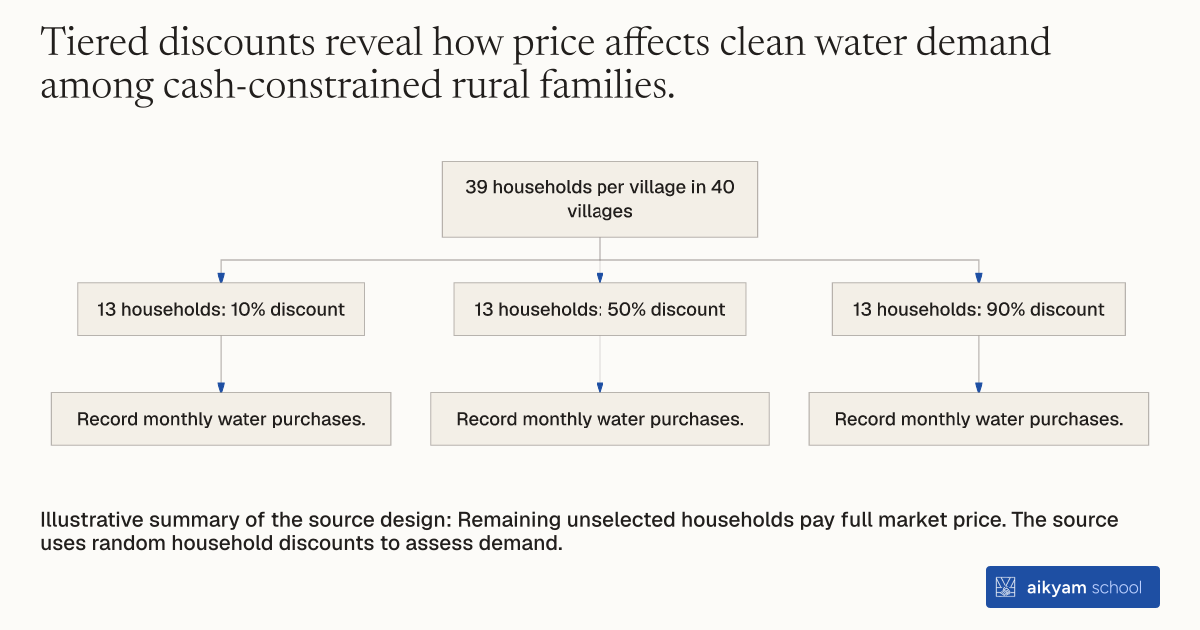
39 households per village in 40 villages
- 13 households: 10% discount
- Record monthly water purchases.
- 13 households: 50% discount
- Record monthly water purchases.
- 13 households: 90% discount
- Record monthly water purchases.
Illustrative summary of the source design: Remaining unselected households pay full market price. The source uses random household discounts to assess demand.
See source →How
When to use
Rural households in low-income regions face contaminated drinking water and severe budgetary constraints. Water providers need pricing models that test price sensitivity while expanding clean water access for poor families. Tiered price discounts allow organizations to evaluate household willingness to pay for door-to-door water delivery.
Offer home-delivered purified drinking water at market price while distributing tiered price discounts to randomized households.
- Spring Health sets full market prices for home-delivered purified drinking water in target villages.
- Field workers distribute scratch cards to randomly assign households to specific discount tiers.
- Assign thirteen households per village to receive a ten percent discount on purchased water.
- Assign thirteen households per village to receive a fifty percent discount on purchased water.
- Assign thirteen households per village to receive a ninety percent discount on purchased water.
- Charge full market price to the remaining unselected households in the village.
- Track household monthly water purchases across each discount tier using company administrative records.
Why it works
Lower prices remove financial barriers, allowing households to substitute contaminated water sources with safe, home-delivered drinking water.
Example
Spring Health offered priced water delivery across 40 villages in rural Odisha, India, with household discount tiers of ten, fifty, and ninety percent. Households purchasing discounted water reduced their instances of sickness by 22 percent and missed 62 percent fewer workdays among active drinkers.
About the study
Participants
40 villages comprising 15,000 households in rural Odisha, India, where median bank balances were INR 2,000 and 26 percent lacked clean water.
Study Design
Randomized controlled trial assigning 40 villages to a priced water intervention, randomizing 39 households per village using scratch cards into ten, fifty, or ninety percent discount tiers.
Results
Water purchases rose as prices dropped, establishing a household willingness to pay of INR 132 per month, while reducing sickness by 22 percent and workdays missed by 62 percent among reporting drinkers.