Try, learn and adjust
Review input advice using farmer profits
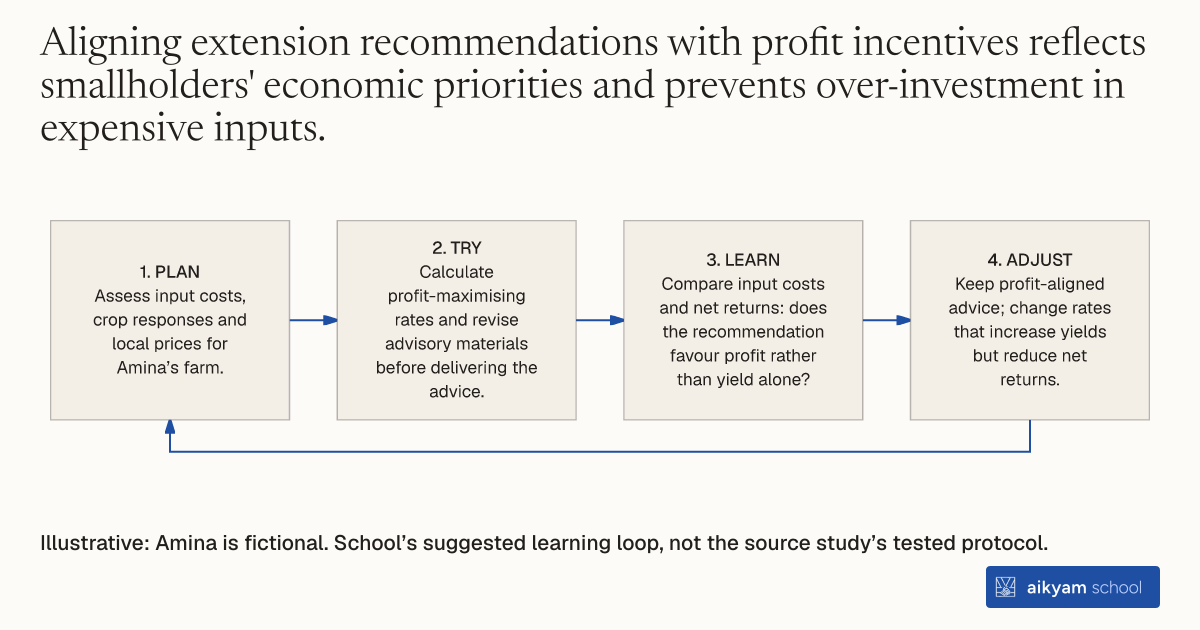
- Plan: Assess input costs, crop responses and local prices for Amina’s farm.
- Try: Calculate profit-maximising rates and revise advisory materials before delivering the advice.
- Learn: Compare input costs and net returns: does the recommendation favour profit rather than yield alone?
- Adjust: Keep profit-aligned advice; change rates that increase yields but reduce net returns.
Illustrative: Amina is fictional. School’s suggested learning loop, not the source study’s tested protocol.
See source →Observe input costs, crop responses, sale prices and net profit. School suggests this learning loop; it was not tested by the source.
How
When to use
Top-down agricultural extension recommendations frequently prioritize maximum crop yield rather than maximum net profit for smallholders. Advisory guidelines derived from controlled test plots often fail to account for input costs and real-world farming constraints. This method helps extension agencies recalibrate input recommendations to maximize farmer financial returns rather than physical harvest volumes.
Recalibrate top-down extension guidelines to align input recommendations with farmer profit maximization rather than maximum crop yields.
- Extension researchers evaluate input costs, local market prices, and crop responses under real farming conditions.
- Extension program managers calculate optimal input application rates that maximize net farmer profits.
- Advisory teams revise extension training materials to replace yield-maximizing targets with profit-maximizing dosage guidelines.
- Extension workers deliver recalibrated recommendations to smallholder farmers during regular advisory trainings.
- Smallholder farmers adjust fertilizer application rates to lower financial input costs and maximize farm profits.
Why it works
Farmers adopt recommendations more readily when advice lowers production risks and increases net revenues.
Example
In Kenya, the Ministry of Agriculture recommended fertilizer amounts aimed at maximizing crop yields, but the optimal amount to maximize smallholder profits was considerably lower. Similarly, in Bali, Indonesia, seaweed farmers rejected NGO extension recommendations because adopting proposed planting distances reduced farmer profits despite increasing overall yields.
About the study
Participants
Smallholder maize farmers in Kenya and seaweed farmers in Bali, Indonesia.
Study Design
Field experiments and randomized evaluations comparing farmer adoption and net financial returns under profit-maximizing rates versus yield-maximizing extension recommendations.
Results
Kenyan extension guidelines recommended fertilizer rates that maximized biological yield rather than farmer profit, which required considerably lower input amounts; in Bali, farmers rejected extension planting recommendations because they reduced net profits despite boosting crop yields.