Try, learn and adjust
Check harvests after saline flooding
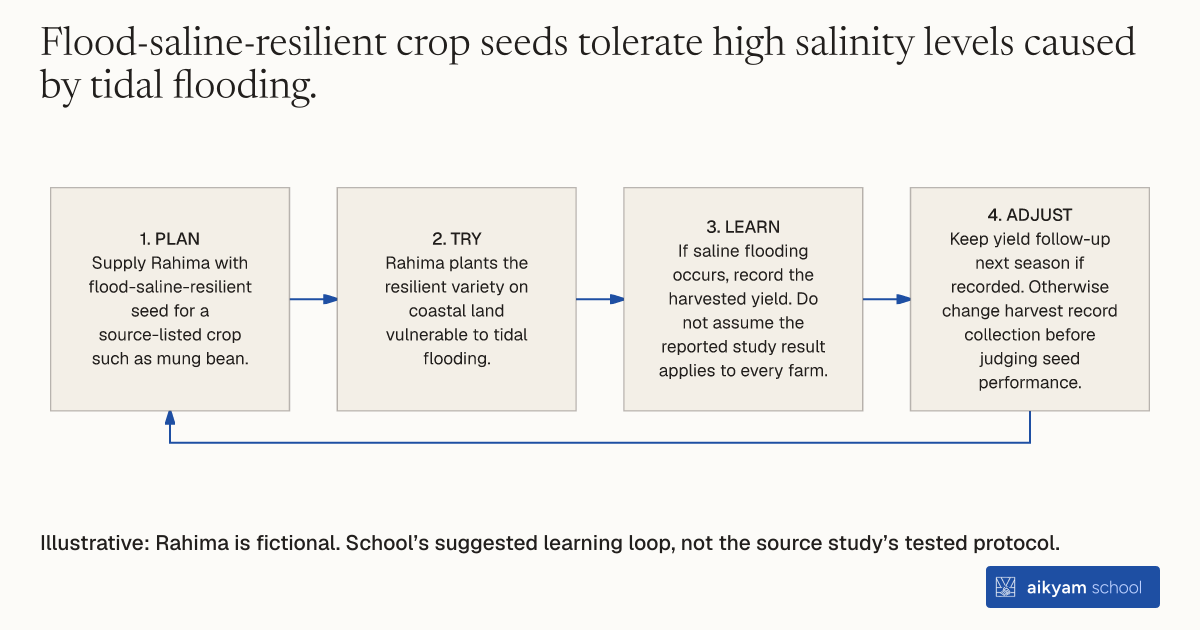
- Plan: Supply Rahima with flood-saline-resilient seed for a source-listed crop such as mung bean.
- Try: Rahima plants the resilient variety on coastal land vulnerable to tidal flooding.
- Learn: If saline flooding occurs, record the harvested yield. Do not assume the reported study result applies to every farm.
- Adjust: Keep yield follow-up next season if recorded. Otherwise change harvest record collection before judging seed performance.
Illustrative: Rahima is fictional. School’s suggested learning loop, not the source study’s tested protocol.
See source →School’s suggested, untested loop. Observe flood exposure, crop variety and harvested yield; no new yield outcome is assumed.
How
When to use
Frequent tidal flooding raises groundwater salinity in coastal farming areas, damaging crops and depressing yields. This practice protects harvest yields from salinity shocks during tidal inundations. It targets smallholder farmers relying on groundwater extraction in coastal agricultural communities.
Distribute flood-saline-resilient crop seeds to smallholder farmers facing tidal flooding and groundwater salinity.
- Extension providers supply farmers with flood-saline-resilient seeds for lentil, mung bean, mustard, sesame, or wheat.
- Farmers plant flood-saline-resilient seed varieties on coastal agricultural fields vulnerable to tidal flooding.
- Tidal floods inundate cultivated farmland, elevating soil and groundwater salinity levels.
- Farmers harvest resilient crop varieties without experiencing yield drops from salinity shocks.
Why it works
Maintaining plant growth during saline shocks prevents crop damage and protects total agricultural output.
Example
In Bangladesh, researchers evaluated groundwater-dependent farmers adopting flood-saline-resilient seeds for lentil, mung bean, mustard, sesame, or wheat in regions prone to tidal flooding. Farmers who adopted the resilient seeds experienced no decline in crop yield following a saline flood, whereas non-recipients faced yield drops of 19 percent.
About the study
Participants
Groundwater-dependent smallholder farmers in tidal flood regions of Bangladesh.
Study Design
Randomized controlled trial comparing adoption of flood-saline-resilient seeds against an untreated comparison group during tidal flood events.
Results
Adopting flood-saline-resilient seeds protected crop yields completely during saline flood events, resulting in no yield loss. Farmers who were not offered the improved seed varieties experienced a 19 percent decline in crop yield following saline flooding.