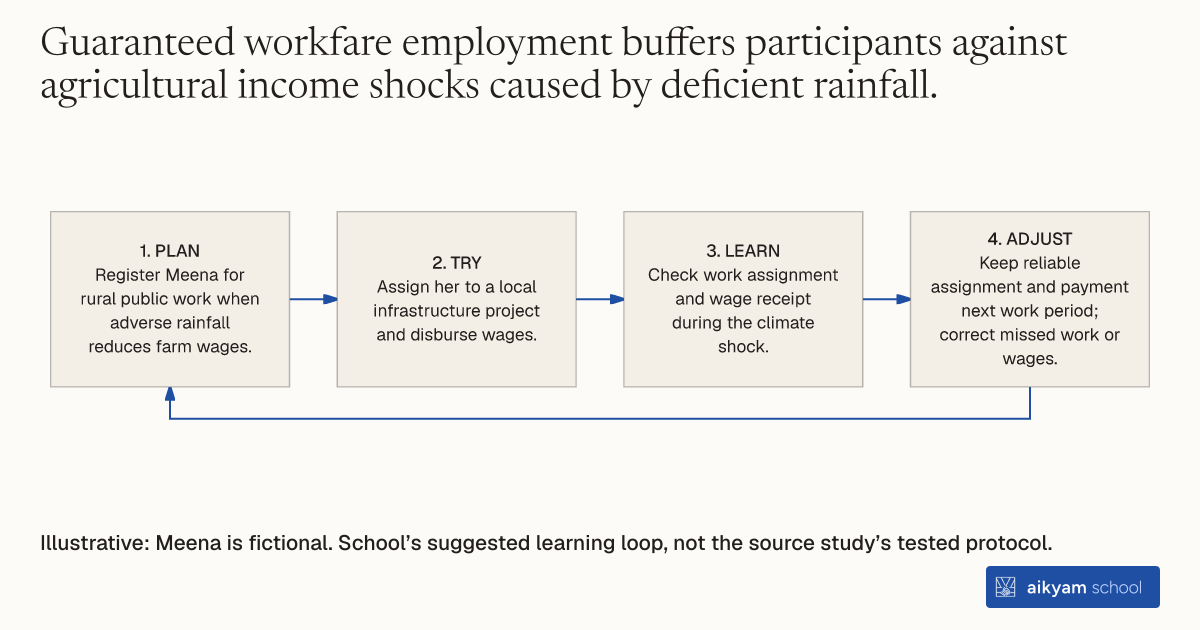
Try, learn and adjust
Check workfare applicants receive assigned work and wages
- Plan: Register Meena for rural public work when adverse rainfall reduces farm wages.
- Try: Assign her to a local infrastructure project and disburse wages.
- Learn: Check work assignment and wage receipt during the climate shock.
- Adjust: Keep reliable assignment and payment next work period; correct missed work or wages.
Illustrative: Meena is fictional. School’s suggested learning loop, not the source study’s tested protocol.
See source →Applications, assignments and wage receipt; no assumed individual conflict outcome. School’s suggested learning loop, not a source-tested cycle.
How
When to use
Rural households in agricultural regions face severe income losses when adverse weather disrupts harvest yields. Drops in farm wages lower the opportunity costs of joining criminal or insurgent violence. This method applies to government social protection agencies seeking to buffer rural workers against climate shocks and reduce local violence.
Provide guaranteed public workfare employment to rural households to insulate local incomes from adverse weather shocks.
- The government passes statutory social protection legislation offering guaranteed public employment to rural workers.
- Program administrators establish local infrastructure projects across rural districts.
- Rural laborers apply for workfare employment when adverse rainfall reduces farm wages.
- Program officers assign registered workers to local infrastructure projects during climate shocks.
- Program managers disburse wage payments to participating laborers to smooth household income in India.
Why it works
Smoothing household incomes raises the opportunity costs of participating in violent conflict during climate events.
Example
In India, the National Rural Employment Guarantee Act insulated participants from agricultural income shocks caused by adverse monsoon rains, leading to reduced conflict in areas where workfare demand increased following low rainfall.
About the study
Participants
Rural households and workers across districts in India.
Study Design
Quasi-experimental natural experiment evaluating the conflict-mitigating effects of the National Rural Employment Guarantee Act during adverse monsoon rainfall shocks (Fetzer 2020).
Results
Guaranteeing public workfare employment insulated participants against agricultural income shocks from adverse monsoons, and areas where program demand increased after low rainfall experienced a reduction in violent conflict.