Try, learn and adjust
Check text-message prices reach the village board
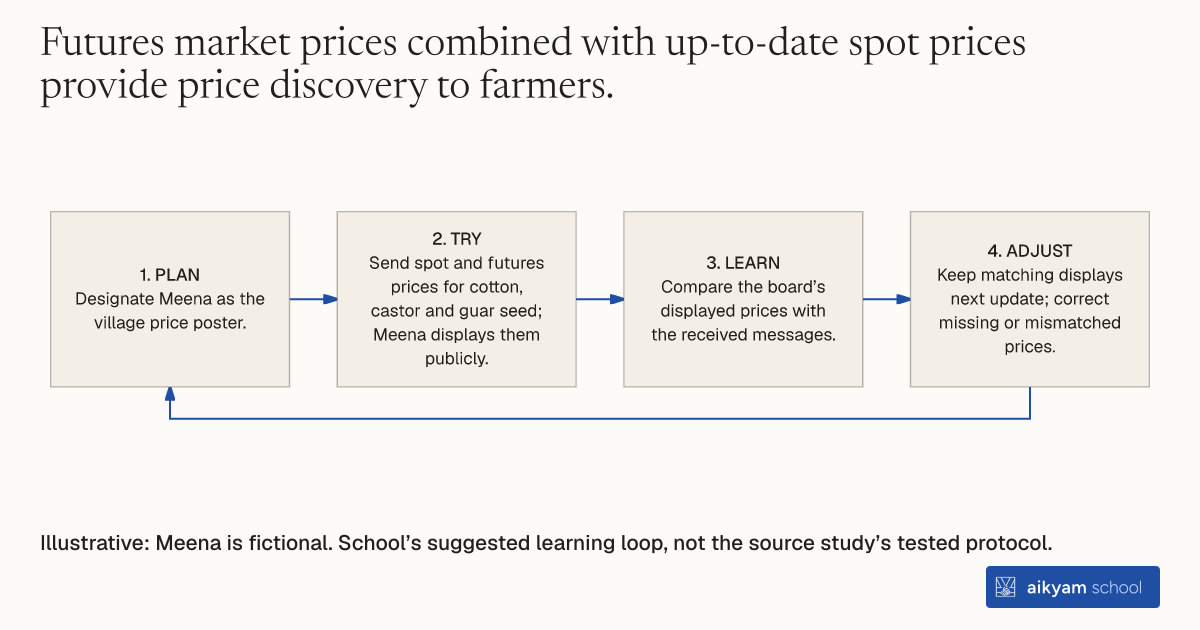
- Plan: Designate Meena as the village price poster.
- Try: Send spot and futures prices for cotton, castor and guar seed; Meena displays them publicly.
- Learn: Compare the board’s displayed prices with the received messages.
- Adjust: Keep matching displays next update; correct missing or mismatched prices.
Illustrative: Meena is fictional. School’s suggested learning loop, not the source study’s tested protocol.
See source →Messages and board prices. The evaluation is ongoing; no planting or income result is reported. School’s suggested learning loop, not a source-tested cycle.
How
When to use
Farmers in developing countries face unpredictable market price risks without access to timely market information. This price uncertainty hinders forward-looking planting decisions and asset accumulation necessary to exit poverty. This method delivers spot and futures price updates to rural farming communities.
Disseminate spot and futures crop price information to rural agricultural communities using text messaging and village bulletin boards.
- Select a designated price poster in each target village to receive price data.
- Send text messages containing spot and futures prices for cotton, castor, and guar seed to the designated price poster.
- Display the received spot and futures prices on public village boards for community viewing.
Why it works
This information helps farmers reduce price uncertainty, make informed planting choices, time harvests better, and negotiate effectively with intermediaries.
Example
Researchers from J-PAL, SEWA, and CMF delivered spot and futures prices for cotton, castor, and guar seed across more than 50 villages in Gujarat, India, by sending text messages to a designated village poster who displayed the information on a public board.
About the study
Participants
Farmers across 108 villages in 4 districts of Gujarat, India.
Study Design
Randomized evaluation conducted by J-PAL researchers in partnership with SEWA and CMF.
Results
Study ongoing; results forthcoming.