Try, learn and adjust
Check spring protection works are complete
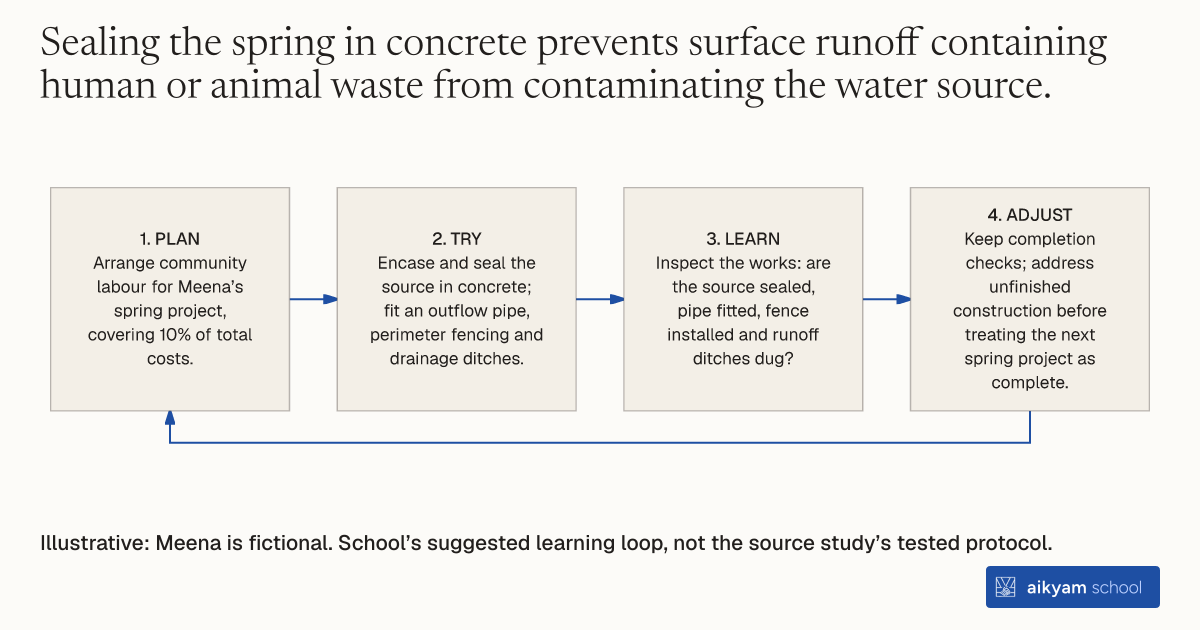
- Plan: Arrange community labour for Meena’s spring project, covering 10% of total costs.
- Try: Encase and seal the source in concrete; fit an outflow pipe, perimeter fencing and drainage ditches.
- Learn: Inspect the works: are the source sealed, pipe fitted, fence installed and runoff ditches dug?
- Adjust: Keep completion checks; address unfinished construction before treating the next spring project as complete.
Illustrative: Meena is fictional. School’s suggested learning loop, not the source study’s tested protocol.
See source →School’s suggested learning loop, not a tested protocol. Observe the sealed source, pipe outflow, fencing and runoff drainage, not assumed water-quality outcomes.
How
When to use
Naturally occurring springs in rural non-arid regions are prone to fecal contamination from surface runoff and human contact during water collection. Organizations seeking to improve drinking water quality at the source need low-maintenance infrastructure solutions. Protection seals off the water source to prevent contamination before water reaches collection vessels.
Encase a natural spring source in concrete masonry and fit an outflow pipe to provide clean drinking water.
- Local community members provide manual labor covering ten percent of total project costs.
- Construction staff seal off the natural source of the spring and encase it in a concrete structure.
- Construction staff install a pipe outflow so water flows directly out rather than seeping from open ground.
- Construction staff install perimeter fencing around the spring site to keep animals away.
- Construction staff dig drainage ditches to divert surface runoff water away from the water point.
Why it works
Water flows out through a pipe, eliminating the need for collectors to dip potentially dirty containers directly into open water.
Example
The non-governmental organization International Child Support protected naturally occurring springs in Busia and Butere-Mumias districts in western Kenya at an average cost of 956 US dollars per spring, with local communities contributing ten percent of costs via labor.
About the study
Participants
184 viable springs serving rural communities across Busia and Butere-Mumias districts in Western Province, Kenya.
Study Design
Randomized evaluation with phased program rollout over four years, measuring E. coli contamination in water samples at springs and households.
Results
Spring protection reduced source fecal contamination by 66% (-1.07 ln E. coli), reduced home water contamination by 24% (-0.27 ln E. coli), and reduced child diarrhea by 25% (-4.7 percentage points).