Try, learn and adjust
Check youth eligibility before registering trade choices
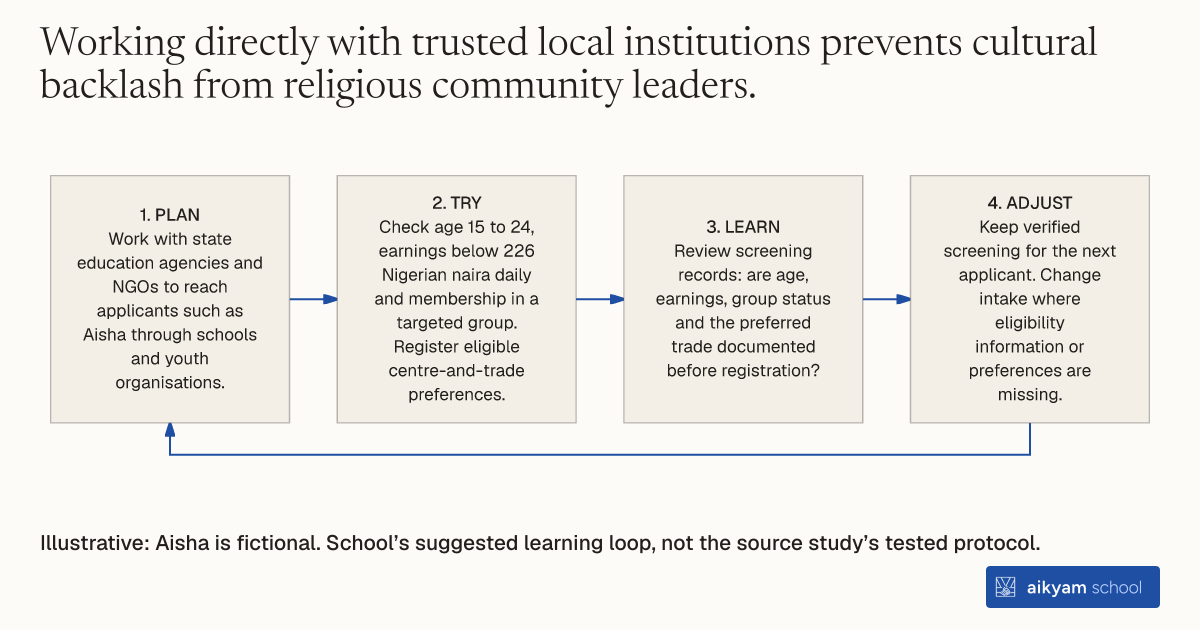
- Plan: Work with state education agencies and NGOs to reach applicants such as Aisha through schools and youth organisations.
- Try: Check age 15 to 24, earnings below 226 Nigerian naira daily and membership in a targeted group. Register eligible centre-and-trade preferences.
- Learn: Review screening records: are age, earnings, group status and the preferred trade documented before registration?
- Adjust: Keep verified screening for the next applicant. Change intake where eligibility information or preferences are missing.
Illustrative: Aisha is fictional. School’s suggested learning loop, not the source study’s tested protocol.
See source →School’s suggested, untested loop. Observe age, income and targeted-group eligibility: Almajiri boys, Islamiyyah girls, early school leavers, orphans or persons with disabilities.
How
When to use
Extremely poor youth in conservative religious settings often lack access to secular training opportunities. Traditional programs fail to reach marginalized populations like Quranic school students and girls in religious education. Screening youth by age, income, and vulnerability status connects underserved groups with vocational training programs.
Identify and select marginalized religious youth for skills training using partner organizations and strict demographic screening.
- Partner with state education agencies and non-governmental organizations that work directly with marginalized youth.
- Visit intake sources such as Islamic schools and youth organizations across target locations in Kaduna and Katsina states.
- Screen potential applicants to confirm they are between 15 and 24 years old.
- Verify that each applicant earns less than 226 Nigerian naira per day.
- Confirm membership in targeted groups including Almajiri Quranic school boys, Islamiyyah girls, early school leavers, orphans, or persons with disabilities.
- Register eligible applicants into center-and-trade combinations based on their preferred trade choice.
Why it works
Clear socioeconomic criteria ensure that limited training resources reach the most impoverished and vulnerable adolescents.
Example
Program consultants visited Islamic schools and local non-governmental organizations in Kaduna and Katsina states in Northern Nigeria. They identified and screened 1,824 eligible youth aged 15 to 24 earning less than 226 naira per day. The pool included 433 Almajiri boys, 428 Islamiyyah girls, 471 orphans and vulnerable children, 388 early school leavers, and 84 persons with disabilities.
About the study
Participants
1,824 eligible youth aged 15 to 24 living in Kaduna and Katsina states, Northern Nigeria, earning less than 226 naira per day.
Study Design
Program consultants collected baseline screening data across centers, verifying age, income, and group status before assigning applicants to trade preferences.
Results
Screening successfully yielded 1,824 eligible applicants across six Community Skills Development Centers, from which 900 youth were assigned to training and 924 to control.