Try, learn and adjust
Check who receives trader cost savings
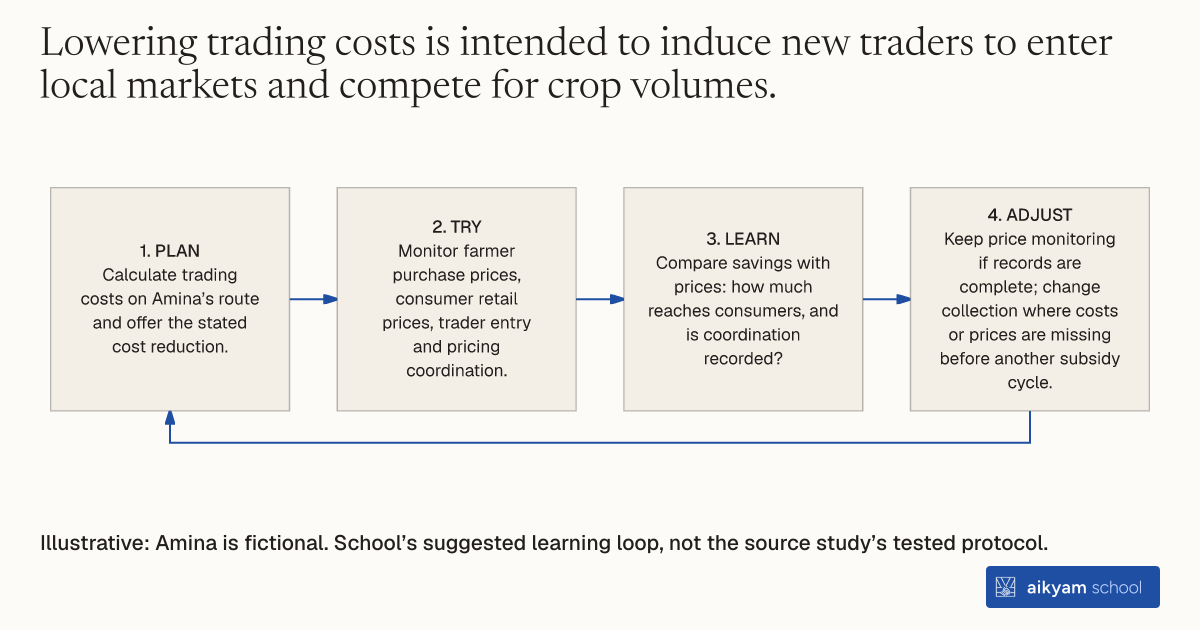
- Plan: Calculate trading costs on Amina’s route and offer the stated cost reduction.
- Try: Monitor farmer purchase prices, consumer retail prices, trader entry and pricing coordination.
- Learn: Compare savings with prices: how much reaches consumers, and is coordination recorded?
- Adjust: Keep price monitoring if records are complete; change collection where costs or prices are missing before another subsidy cycle.
Illustrative: Amina is fictional. School’s suggested learning loop, not the source study’s tested protocol.
See source →Observe pass-through and coordination. In Kenya, traders passed through 22% and captured about 80%; do not treat these as an exact split. School suggests this learning loop; it was not tested by the source.
How
When to use
Agricultural traders often face high operational and transport costs when sourcing crops from rural markets. High intermediary costs depress prices paid to farmers and increase consumer prices in local markets. Offering cost reductions to local traders aims to stimulate market entry, increase market competition, and lower consumer purchase prices.
Provide cost reduction subsidies to agricultural traders to encourage market competition and lower consumer prices.
- Identify major agricultural trading routes and local crop markets with elevated transaction costs.
- Calculate average operational and transportation expenses incurred by intermediary traders.
- Offer direct cost reductions or operational subsidies to licensed agricultural traders operating along target trading routes.
- Monitor regional crop purchase prices paid to rural farmers and final retail prices charged to consumers.
- Track market entry rates and pricing coordination among participating traders.
Why it works
Increased competition among intermediary buyers should theoretically force traders to pass cost savings along to consumers through reduced retail prices.
Example
In Kenya, researchers offered local maize traders operational cost reductions to evaluate how market competition behaved, finding that traders passed through 22 percent of the value from reduced costs to consumers while colluding to capture 80 percent of the value.
About the study
Participants
Local maize traders and consumers in Kenya.
Study Design
Randomized Evaluation (RCT).
Results
Offering cost reductions to traders resulted in traders passing through 22 percent of the value to consumers through lower prices while capturing about 80 percent of the value by colluding with other traders.